
Best AI Tools for Essay Planning: 7 Smarter Ways to Plan

You have the assignment question. You have three browser tabs open. You have saved six sources, and you even know roughly what you want to argue. But your document is still blank, because you can’t decide what should come first.
That is not a writing problem. It is a planning problem, and it is exactly where AI tools for essay planning can help without writing the essay for you.
Good essay planning is more than generating headings. It means deciding what you are arguing, why that argument is defensible, what evidence you need, and how each paragraph moves the reader toward your conclusion.
What Are the Best AI Tools for Essay Planning?
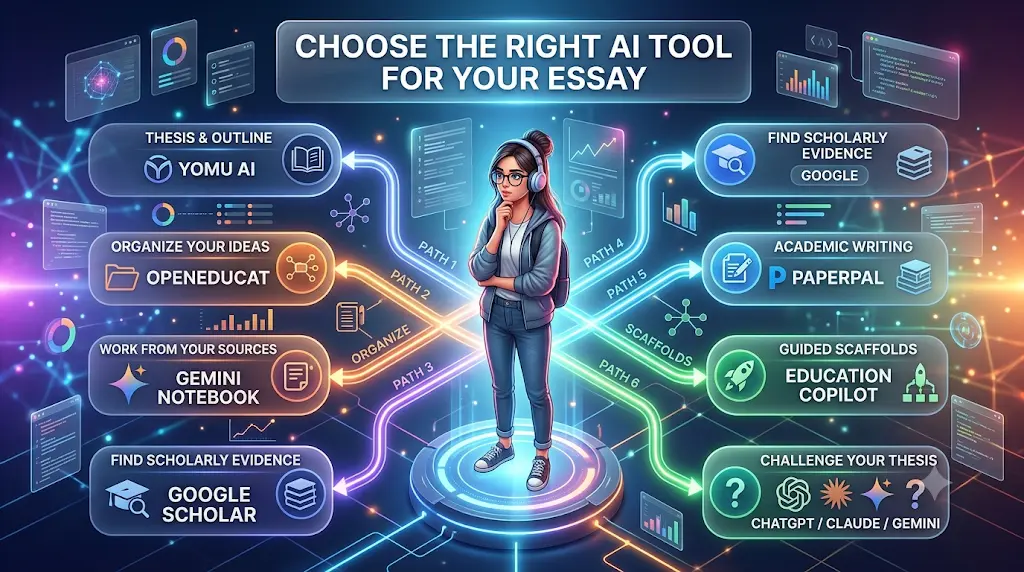
The best AI tools for essay planning each cover a different stage of the job. Yomu AI is our top pick for turning a topic into a thesis and outline, because it covers more of the planning workflow (debate, thesis, structured outline) without requiring a paid plan to start. Gemini Notebook suits planning from sources you already have, Google Scholar helps you find evidence, and Paperpal supports academic editing after the plan is done.
Which should you choose? Match the tool to your problem:
- Need a thesis and structured outline? Start with Yomu AI.
- Already have PDFs or class notes? Use Gemini Notebook to work from those sources.
- Need scholarly sources? Use Google Scholar alongside your planner.
- Need academic editing after planning? Consider Paperpal.
- Want to challenge your argument in conversation? Use a general AI assistant such as ChatGPT, Claude or Gemini.
Before submitting your assignment, learn how to use AI ethically for academic writing to avoid plagiarism and create original work.
What Is an AI Essay Planner?
An AI essay planner is a tool that helps students turn an assignment prompt into a structured plan. It does this by brainstorming ideas, developing a thesis, organizing arguments, identifying where evidence is needed, and creating an outline before the essay itself is written.
Planning vs writing. Planning is thinking, organizing and structuring. Writing is producing the sentences. A weak plan produces a weak essay however polished the sentences are, which is why planning is the smarter place to use AI.
What Makes a Good Essay Plan?
A good plan answers five questions:
- What exactly is the assignment asking?
- What is my central argument?
- What evidence supports each major claim?
- Why does each paragraph belong in this order?
- What could challenge my argument?
If an AI-generated outline cannot answer these, it is a starting point, not a finished plan.
The PLAN Framework: A Four-Stage Method
PLAN is FutureFastAI’s framework for planning an essay with or without AI.
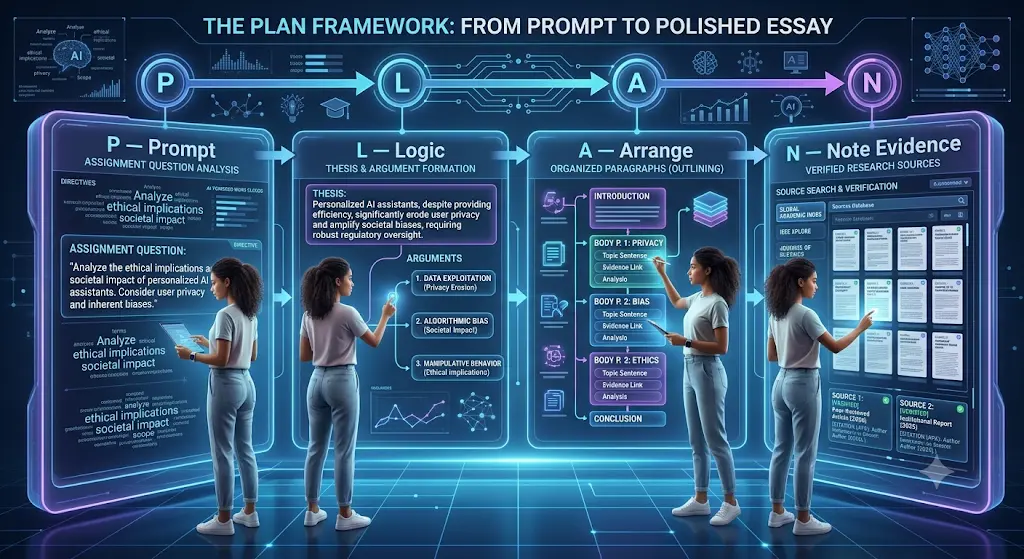
- P — Prompt: Identify the task word (discuss, evaluate, compare), the scope, the subject and the evidence required.
- L — Logic: Develop a specific thesis and decide which arguments can genuinely support it.
- A — Arrange: Order the strongest arguments so each paragraph builds on the previous one.
- N — Note Evidence: Identify what evidence each claim needs, and verify the sources before you write.
Most free AI tools for essay planning handle A. Far fewer help with L and N, which is where essays are won or lost.
The goal is not an AI-generated outline. The goal is a defensible plan that you understand well enough to write without the AI.
The 30-Second Quality Test
Before you trust any AI-generated outline, ask:
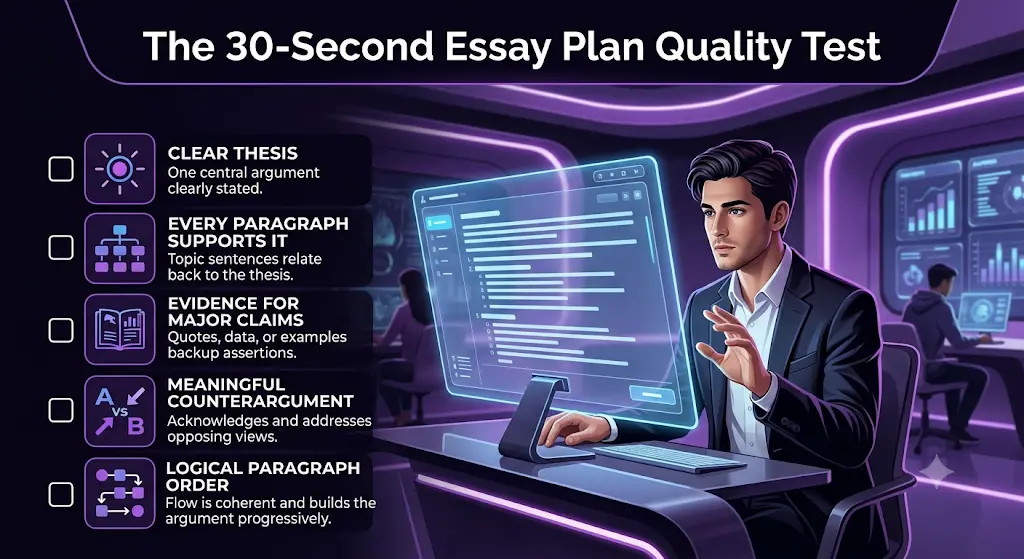
- Can I explain the thesis in one sentence?
- Does every body paragraph support it?
- Does each major claim have evidence attached?
- Is there a meaningful counterargument?
- Could I explain why the paragraphs are in this order?
If you answer “no” to two or more, fix the plan before you start writing.
Planning Before Prompting
Before you open any AI tool, write three lines yourself:
- My initial position: ______
- What I already know: ______
- What I need to prove: ______
Then give those lines to the AI. This keeps the workflow as your thinking → AI challenge → your decision, instead of AI thinking → you copying.
How We Evaluated These Tools
To compare AI tools for essay planning fairly, we prioritized official product pages for feature and pricing checks. Where an official source did not give a current price or limit, we label the information as unverified or as sourced from a third party, rather than presenting it as confirmed. All checks were done on October 7, 2026. This is a documentation-based evaluation, not a hands-on lab test, and we don’t claim months of personal use.Looking for the best AI tools for writing college assignments? Explore our detailed guide to discover the top AI writing assistants that help you research, draft, edit, and improve academic assignments faster while maintaining quality and originality.
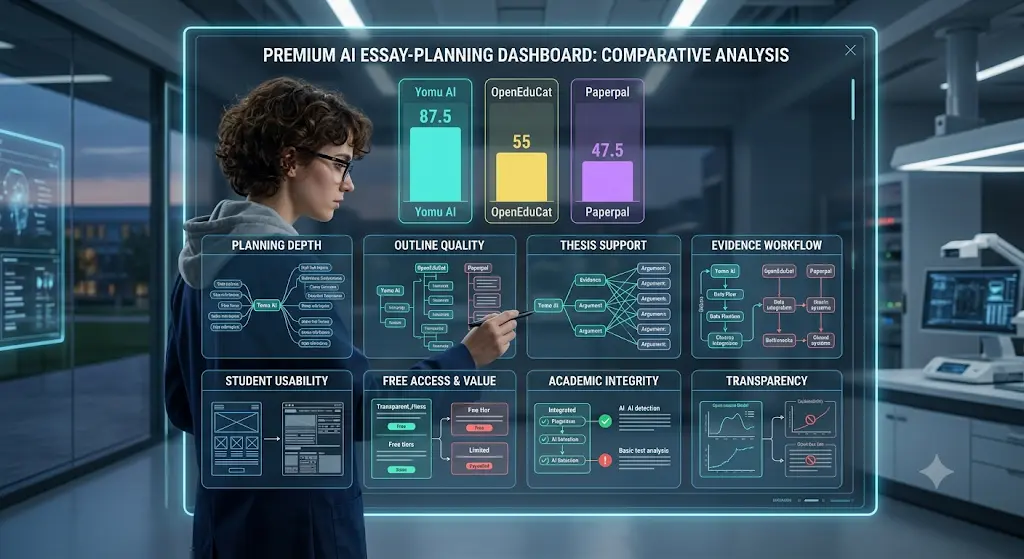
The Essay Planning Score
Each tool is scored 0, 1 or 2 on eight criteria (0 = not documented, 1 = partly documented, 2 = clearly documented). Points equal weight × (score ÷ 2).
- Essay-planning depth (25 points)
- Outline quality (15)
- Thesis and argument support (15)
- Evidence and research workflow (15)
- Student usability (10)
- Free access and value (10)
- Academic integrity support (5)
- Transparency about limits (5)
Results (out of 100, documentation-based):
- Yomu AI: 87.5. Documented debate, thesis and outline tools, a free route, and clear pricing. Evidence support is limited to hints on the free tools.
- OpenEduCat Essay Outline Generator: 55. Strong outline structure with evidence slots, but no documented thesis development and unverified ongoing pricing.
- Paperpal: 47.5. Strong on research and citation support, but we found no documented planning, thesis or outline features. It is scored on planning, not on its real strength, academic writing.
A lower score does not mean a worse tool. It means a tool is less focused on this particular job.
The 7 Best AI Tools for Essay Planning
1. Yomu AI: Best Overall for Thesis and Outline
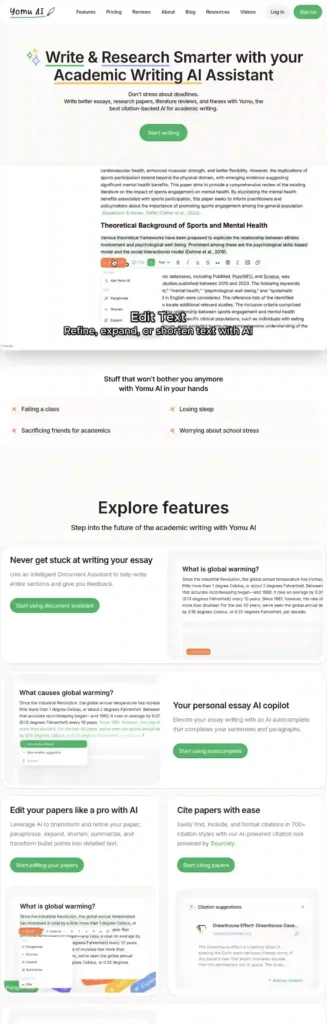
Best for: Students who want one workflow from idea to outline.
Why it stands out: Yomu AI is an academic writing assistant with free planning tools. Its outline generator covers argumentative, persuasive, analytical, expository and narrative essays, plus college application and scholarship essays. You choose the essay type, academic level (high school, college or graduate) and number of body paragraphs, then export to Google Docs, Word or PDF. Its free thesis statement generator and debate generator help you explore both sides before you commit.
Key planning capability: Thesis → debate → outline, with evidence hints and counterargument sections.
Free access: The outline, thesis and debate tools are listed as free with no credit card required.
Pricing (verified October 7, 2026, at about ₹96 per USD):
- Pro: 10/monthbilledannually(120/year, about ₹11,500), or $21/month billed monthly (about ₹2,000). Includes 1,000 AI actions per month.
- Ultra: 17/monthbilledannually(204/year, about ₹19,600), or $35/month billed monthly (about ₹3,400). Unlimited AI actions.
Source: Yomu AI pricing and its essay outline generator.
Upgrade trigger: Paying makes sense when you write several long assignments a month, work with many PDFs, or want planning and drafting in one workspace. For one or two essays a semester, the free tools are likely enough.
Value-for-Money Rating: Strong for the free tools; moderate for paid plans, which are priced in USD.
Student example (illustrative, not a real case): Imagine a second-year commerce student, Ravi, with a 1,500-word argumentative essay due Friday. He tests thesis directions, picks one, generates a four-paragraph outline, and replaces the generic evidence hints with sources he finds himself.
Watch out: Outlines can be generic, and evidence hints are prompts, not verified sources.
Better suited than a general assistant to: structured academic outlines. A general assistant is more flexible for open-ended brainstorming.
Choose it if you want an academic workspace beyond a one-off outline. Skip it if you only need a quick structure and will write everything yourself.
Verdict: Best all-round starting point for thesis and outline work.
2. OpenEduCat AI Essay Outline Generator: Best for Outlines From Your Own Ideas
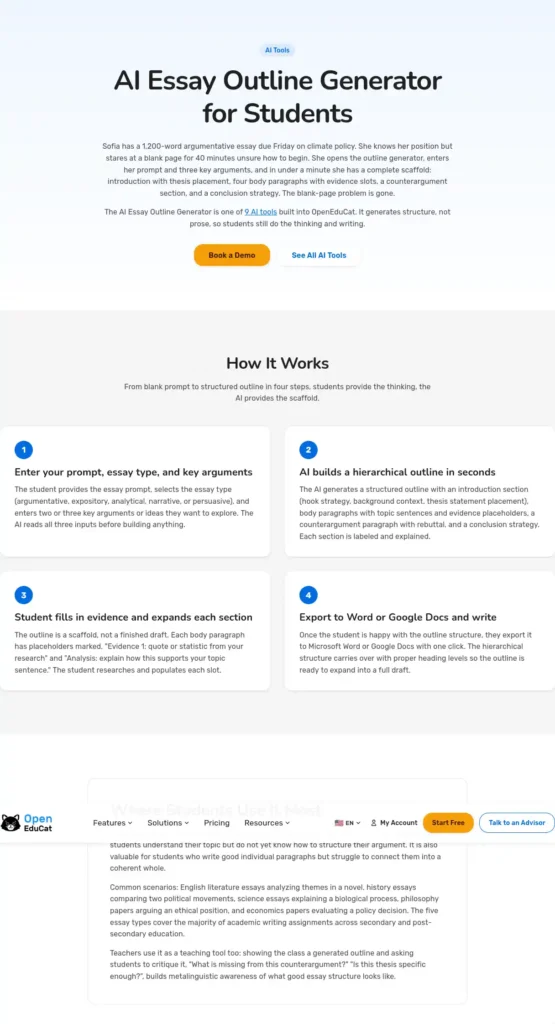
Best for: Students who already have two or three rough arguments.
Why it stands out: It is one of nine AI tools in the OpenEduCat education platform. You enter the prompt, essay type and key arguments; it returns a hierarchical outline with thesis placement, evidence slots and a counterargument section. The vendor describes the result as a scaffold, not a draft.
Key planning capability: Arranging your ideas (the A and N of PLAN).
Free access: The vendor page mentions a 15-day free trial. Ongoing student pricing is unverified.
Watch out: It won’t help you find a thesis from scratch, and it sits inside a school platform.
Better suited than a conventional outline generator to: building structure around arguments you have already chosen.
Choose it if you want your own ideas organized. Skip it if you need help deciding what to argue.
Verdict: A good second tool once you have a thesis direction.
Source: OpenEduCat.
3. Gemini Notebook (previously NotebookLM): Best for Planning From Your Own Sources
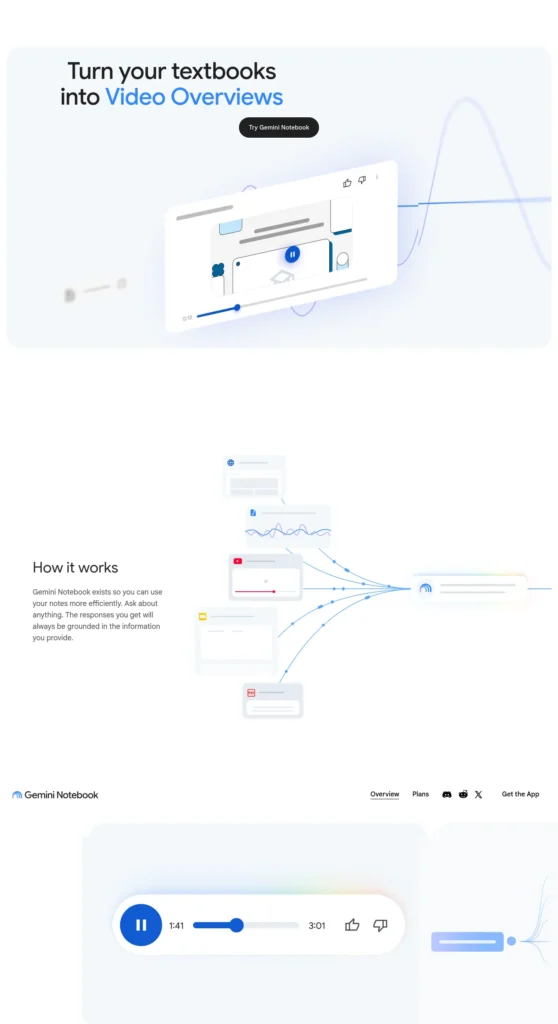
Best for: Students with PDFs, readings or lecture notes already collected.
Why it stands out: Gemini Notebook is Google’s source-grounded research notebook, previously named NotebookLM. A university IT notice from July 17, 2026 reports the rename, and Google’s own announcement is cited by several reports; we could not open Google’s page directly, so check it before relying on details. You upload sources and ask questions answered from them.
Key planning capability: The N in PLAN: which of my sources support which claim?
Free access: A free tier exists, but limits change. Check Google’s current plan page.
Watch out: It reflects only the sources you give it, and it won’t replace reading them.
Better suited than a general assistant to: keeping answers tied to material you already collected.
Choose it if you already have readings. Skip it if you have no sources yet.
Verdict: The best tool for mapping evidence to claims.
Source: NC State OIT notice.
4. Google Scholar: Best Free Source Finder
Best for: Finding and checking scholarly sources.
Why it stands out: Google Scholar is a free search engine for scholarly literature. It is not an AI planner, but a plan is only as strong as its evidence, and it is the quickest place to confirm that a source an AI mentioned actually exists.
Key planning capability: Evidence discovery and checking.
Free access: Free.
Watch out: It finds sources but doesn’t judge their quality or relevance, and some papers are paywalled.
Choose it if your essay needs academic sources. Skip it if your assignment uses only class readings.
Verdict: Keep it open in a second tab while you plan.
5. Paperpal: Best for Moving From Plan to Academic Draft
Best for: Final-year and postgraduate students writing research papers.
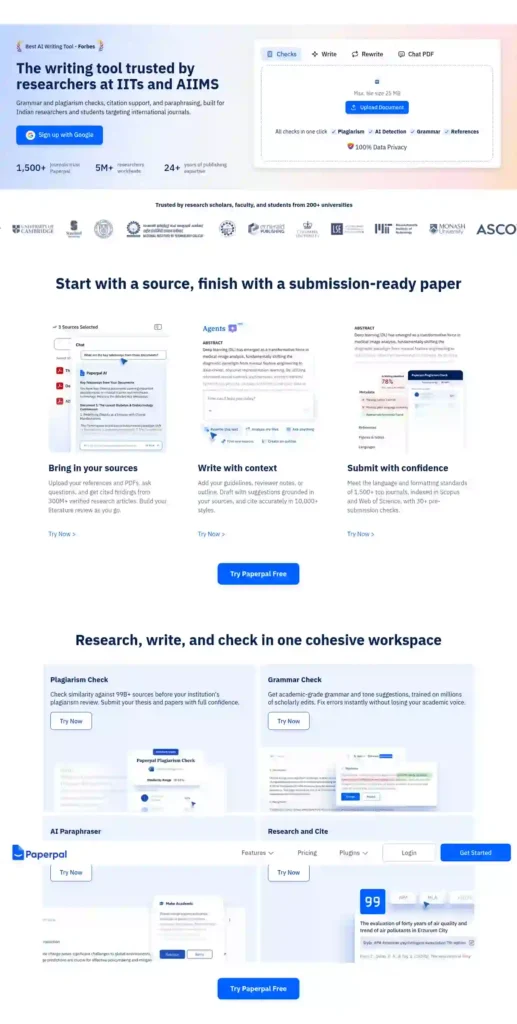
Why it stands out: Paperpal is an academic writing and research assistant from Cactus Communications. Its company listing describes writing, editing, search and citation support, including references from 250M+ research articles, PDF summaries and citations in 10,000+ styles.
Key planning capability: Research and citation support (not outlining).
Free access: A free version exists. Its limits are reported inconsistently across sources, so confirm them on Paperpal’s site.
Pricing (company listing; verified October 7, 2026): Prime starts at $25/month (about ₹2,400). Third-party directories list $55 per quarter (about ₹5,300) and $139 per year (about ₹13,300); treat those two as unconfirmed.
Watch out: It is stronger at writing and editing than brainstorming, and Prime is costly in rupees.
Choose it if you are moving from an approved plan into drafting. Skip it if you only need a plan for a short essay.
Verdict: A drafting-stage tool, not a planning-stage tool.
6. Education Copilot: Best for Teacher-Style Scaffolds
Best for: Students who like guided, template-style planning.
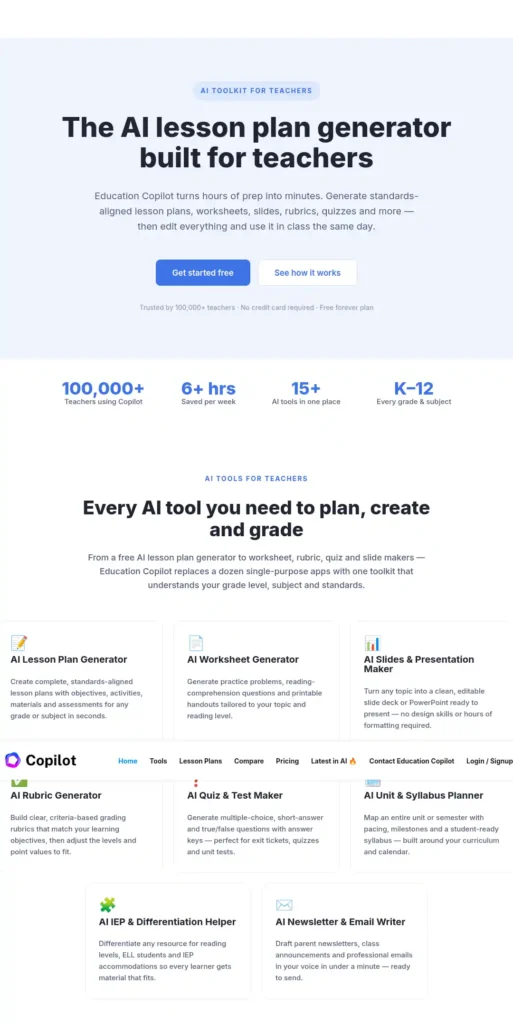
Why it stands out: It is a web-based AI platform aimed at teachers creating lesson plans and handouts. Common Sense Education describes it as free to try, with up to five free items before editing and deleting are restricted.
Key planning capability: Structured prompts and templates.
Free access: Free to try, capped at five items. A third-party directory lists $9/month for a paid tier (about ₹860); we could not confirm this on an official page.
Watch out: It is built for teachers first, so some tools won’t fit student essays.
Choose it if you want scaffolds. Skip it if you want help building your own argument.
Verdict: Useful for structure, less so for argument.
Source: Common Sense Education review.
7. ChatGPT, Claude or Gemini: Best for Challenging Your Thesis
Best for: Brainstorming and stress-testing an argument.
Why it stands out: ChatGPT (OpenAI), Claude (Anthropic) and Gemini (Google) are general assistants. Their strength is conversation: asking for your strongest counterargument, weaknesses or clarifying questions. Meta’s student guide similarly frames AI outlining as a sequence from brainstorming to structure checks, not essay generation.
Key planning capability: The L in PLAN: developing and testing logic.
Free access: Free tiers exist, but limits change often. Check each company’s plan page.
Watch out: They can produce citations that look real but aren’t.
Choose one if you want a thinking partner. Skip it if you expect it to verify your sources.
Verdict: Best for the thinking stage, weakest for the evidence stage.
What Can AI Essay Planners Get Wrong?
Even good tools have predictable weaknesses:
- Generic thesis statements. A thesis can be technically arguable yet too broad to defend in your word count.
- Formulaic outlines. A five-paragraph structure isn’t automatically right for your assignment.
- Unsupported evidence suggestions. AI may suggest evidence without confirming that it exists.
- False balance. AI may present “both sides” even when the evidence strongly favours one.
- Over-structuring. A very detailed outline can make you follow the AI instead of thinking.
The best AI essay planner is not the one that produces the longest outline. It is the one that helps you make better decisions about your own argument.Before you start writing your assignment, it’s important to know how to use AI for college research projects effectively. A strong research process helps you find credible sources, organize ideas, and avoid common mistakes that can lower your grades.
An Illustrative Example: Weak vs Better Planning Output
Illustrative example, not real student work. Essay question: “Should universities require students to attend lectures in person?”
Weak AI output: Introduction → Benefits → Disadvantages → Conclusion.
Better planning output: Thesis → attendance-policy context → strongest benefit → strongest objection → evidence comparison → counterargument → qualified conclusion.
The second plan commits to a position, tests it against its best objection, and ends with a conclusion that reflects the evidence. The first just lists topics.
When Should You Avoid AI Planning?
Skip AI, or pause it, when:
- the assignment explicitly bans AI
- you haven’t understood the topic yourself yet
- the tool is replacing your thinking instead of challenging it
- you haven’t checked the sources
- the generated structure feels generic
Sometimes the fastest way to improve a plan is to close the AI tool and spend ten minutes thinking about the question yourself.
Which AI Tool Is Best for Each Essay Task?
What is the best AI tool for brainstorming essay ideas?
A general assistant such as ChatGPT, Claude or Gemini. Ask for five defensible approaches and each one’s biggest weakness. It won’t know your course content unless you paste it in.
What is the best AI tool for thesis statements?
Yomu AI’s free thesis statement generator is a direct fit. Check that the result is arguable and narrow enough for your word count.
What is the best AI tool for essay outlines?
Yomu AI for a complete outline with essay-type formats, or OpenEduCat if you want to start from your own arguments. Neither verifies your evidence.
What is the best AI tool for essay research?
Gemini Notebook for mapping sources you already have, plus Google Scholar for finding more. You still have to read and judge them.
What is the best AI tool for argumentative essays?
Yomu AI, because its debate generator lets you explore both sides before committing. It won’t tell you which side the evidence supports.
What is the best free AI tool for essay planning?
Start with Yomu AI’s free generators, then add a general assistant to question your thesis. Free tiers change, so confirm current limits.
What is the easiest AI essay planning tool for beginners?
Yomu AI’s outline generator: you choose the essay type and level and get a clear structure. Beginners should still question the first outline they receive.
How to Use AI to Plan an Essay in 20 Minutes
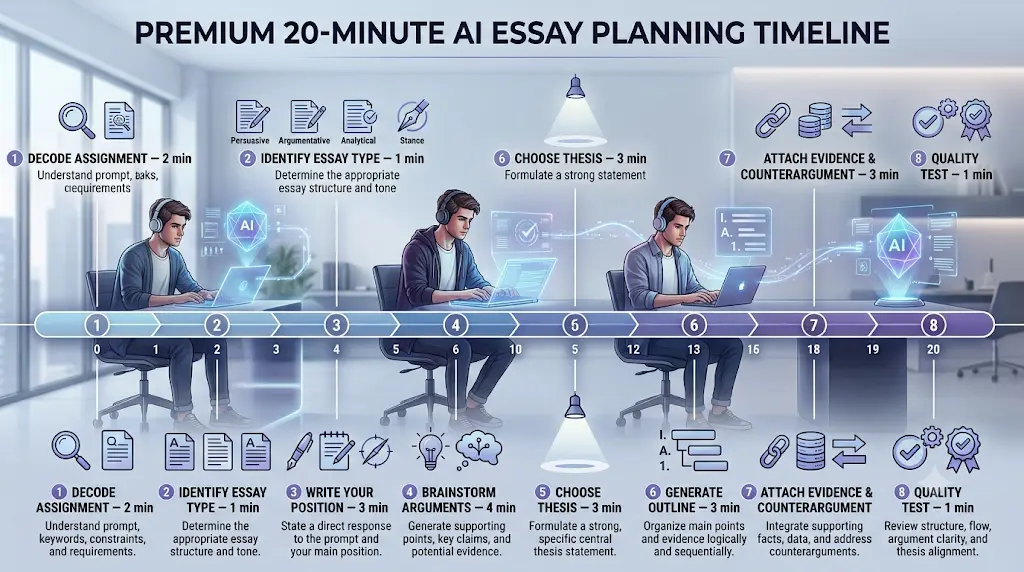
- Decode the assignment (2 min). Underline the task words and the scope.
- Name the essay type (1 min). Argumentative, analytical, research?
- Write your own position (3 min). Use the Planning Before Prompting lines above.
- Brainstorm 3–5 arguments with AI (4 min).
- Choose one thesis direction (3 min).
- Generate the outline (3 min).
- Attach evidence needs and a counterargument (3 min).
- Run the 30-Second Quality Test (1 min).
Then write from your own plan. Do steps 1–5 as soon as the essay is set; an early thesis saves hours.
Which Prompts Work Best for Essay Planning?
Copy these and replace the bracketed parts.
Brainstorming prompt
Help me brainstorm five defensible approaches to this essay question: [question]. Don’t write the essay. For each approach, explain the central argument, possible evidence, and biggest weakness.
Thesis prompt
Based on this question and my position ([your view]), give me three thesis directions. Make each specific, arguable, and narrow enough for a [1,500]-word essay.
Outline prompt
Turn my thesis and arguments into a logical outline. For every body paragraph, identify the claim, evidence needed, analysis, and connection to the thesis.
Counterargument prompt
Identify the strongest reasonable counterargument to each major claim and what evidence I would need to respond.
Logical-flow prompt
Point out any paragraph in my outline that doesn’t clearly support my thesis. Don’t rewrite it.
Bad prompt: “Write my essay outline.” Better prompt: “Help me evaluate three possible arguments. Don’t write the essay. For each, identify the thesis direction, evidence needed, a counterargument, and a weakness.”
The better prompt gives the AI a job, a boundary and a format.
Word-Count Planning
A common starting split for a 1,000-word essay: introduction 100–150, three body paragraphs of about 200 each, a counterargument of about 150, and a conclusion of 100–150. Always follow your assignment’s instructions.
Can AI Help You Find Evidence for an Essay?
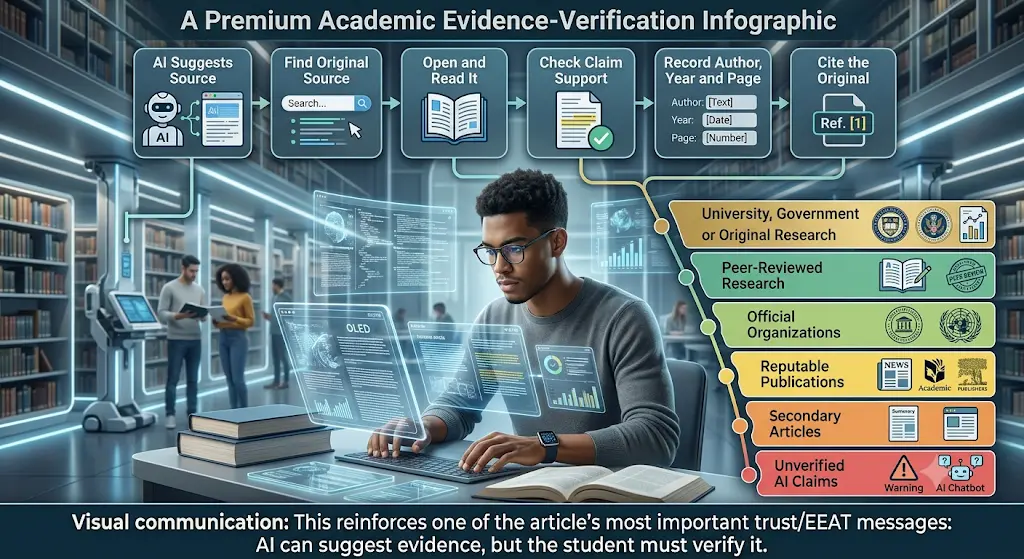
AI can help you look for evidence. It cannot be trusted to verify it. Finding a source is not verifying it, and an AI-generated citation is not automatically a real one.
How to Verify an AI-Suggested Source
- AI suggests a source.
- Find the original on Google Scholar or your library database.
- Open it.
- Check that it actually supports your claim.
- Record the author, year and page or section.
- Add the citation from the original, not from the AI.
A Source Quality Ladder
From strongest to weakest: university, government or original research → peer-reviewed research → official organization → reputable publication → secondary article → an AI claim with no source (treat as unverified).
Should You Use One AI Tool for the Entire Essay?
Usually not. The strongest AI tools for essay planning work as a chain, not a single app: assignment prompt → planning tool → source discovery → evidence check → your outline → your writing → AI feedback on structure. Steps one, four, five and six belong to you. Responsible AI use looks like Think → Ask → Challenge → Verify → Adapt → Write, not Prompt → Copy → Submit.Struggling to finish assignments before the deadline? Discover the best AI tools for assignment planning and deadline management that help you organize tasks, prioritize work, and submit projects on time.
Is It Okay to Use AI for Essay Planning?
It depends on your institution, instructor and assignment, so check the AI policy first. We can’t promise that AI planning is allowed everywhere.
Often lower-risk: brainstorming, questioning your own argument, outlining, finding gaps, explaining concepts, and feedback.
Higher-risk: submitting AI-written prose as your own, using unchecked citations, copying AI-generated arguments, hiding AI use where disclosure is required, and ignoring an instructor’s rules.
Which AI Tools for Essay Planning Work for Indian Students?
Indian students often face dollar pricing that feels steep in rupees, mobile-data limits, and assignments ranging from engineering reports to humanities essays.Don’t waste hours jumping between AI tools that barely help—discover these powerful AI tools for academic writing for students that can help you build a smarter research-to-writing workflow.
- Start free. Yomu’s outline and thesis generators and Google Scholar cost nothing.
- Know the rupee cost. At about ₹96 per USD, Yomu Pro is about ₹960 per month billed annually or about ₹2,000 billed monthly; Paperpal Prime starts around ₹2,400 per month.
- Pay for a clear need, such as long PDFs or heavy research, not a single essay.
- Check your university’s rules. AI policies vary by university and sometimes by department.
For more budget-friendly options, see our guide to best free AI tools for students.
Which Tool Should You Choose?
- Choose Yomu AI if you need thesis and outline help.
- Choose Gemini Notebook if you already have sources and notes.
- Choose Google Scholar if your biggest problem is finding academic evidence.
- Choose Paperpal if you’re moving from planning into academic writing.
- Choose a general AI assistant if you want to challenge and refine your thinking.
- Use more than one when the assignment needs both planning and source verification.
Frequently Asked Questions
What is the best AI tool for essay planning?
Yomu AI is our top all-round pick for essay planning because it covers thesis, debate and outline tools with free access. For source-based planning, Gemini Notebook fits better; for brainstorming, a general assistant works well. The best choice depends on your planning stage.
Can AI help me plan an essay without writing it for me?
Yes, AI can help you plan an essay without writing it for you. Ask for approaches, weaknesses and counterarguments rather than paragraphs, and state “don’t write the essay” in your prompt. Then write from your own outline.
What is the best free AI essay planner?
Yomu AI’s free outline and thesis generators are the strongest free starting point we found, based on its pages as of October 7, 2026. Free plans change often, so confirm limits before relying on them for a deadline.
Which AI tool is best for creating an essay outline?
Yomu AI is best for a complete outline with essay-type formats, while OpenEduCat suits students who already have two or three key arguments. Replace generic evidence hints with sources you have checked yourself.
Can AI help me develop a thesis statement?
Yes, AI can help you develop a thesis statement. Yomu AI offers a free thesis generator, and general assistants can suggest directions. Make sure the final thesis is specific, arguable and narrow enough for your word count.
Can AI help me plan a research paper?
Yes, AI can help you plan a research paper. Use a planner for structure, Google Scholar for sources and Gemini Notebook to map readings to claims. You still need to read the sources yourself.
Can AI tools find reliable sources for an essay?
AI tools can suggest leads, but reliability is your job to confirm. Check that every source exists, read the relevant passage, and cite the original. Google Scholar is a good place to confirm a source an AI mentioned.
Can I use AI for essay planning in college?
Whether AI essay planning is allowed depends on your institution and assignment policy. Some instructors permit brainstorming and outlining; others ban AI entirely. Read your course policy, and ask your instructor if it is unclear.
Should I use AI-generated citations?
No, AI-generated citations should not be trusted without verification. AI can produce references that look real but don’t exist or don’t say what it claims. Find the original source, confirm the details, and cite that.
Is an AI essay outline considered cheating?
An AI essay outline is considered cheating only if your institution’s rules say so or you present AI work as your own. Using AI to organize your own ideas is often treated differently from submitting AI-written text. Check your policy first.
Your Next Step
The best AI tools for essay planning only help when you use them on a real task. Pick one assignment you have this week. Spend 20 minutes on the workflow above, and try the free option first to see whether it fits before paying for anything. If you want to go deeper, see our guides to AI tools for beginners, AI tools for research projects and AI tools for writing.
Sources and Verification
Official pages were prioritized; third-party sources are labeled. Prices change quickly, so confirm before you buy.
- Yomu AI pricing (official)
- Yomu AI essay outline generator (official)
- OpenEduCat essay outline generator (official)
- Paperpal (official site; Prime $25/month from the company listing; quarterly and annual prices from third-party directories)
- NC State OIT: NotebookLM changes name to Gemini Notebook (university notice, third-party)
- Google Scholar (official)
- Common Sense Education: Education Copilot (third-party review)
- Meta AI: how to use AI to write an essay outline (official)
- USD/INR of roughly ₹95–96 per USD, from public currency data, July–September 2026
About the Author
Nandhakumar is the Founder & Content Creator at FutureFastAI, where he writes about AI tools, study workflows, and digital productivity for students and beginners. His work focuses on practical, responsible ways to use AI for research, learning, planning, and everyday tasks. He reviews tools using publicly available product information, official documentation, and clearly stated evaluation criteria, with an emphasis on accuracy and student usefulness
Editorial Policy
FutureFastAI prioritizes accurate, useful, and transparent AI guidance. Tool features, pricing, free-plan limits, and availability are checked against official sources where possible and updated when significant changes are identified. We clearly distinguish verified information from third-party claims and do not present AI-generated content, citations, or capabilities as reliable without appropriate verification. Our recommendations are based on practical usefulness, student needs, usability, value, and responsible AI use.