
AI Tools for Learning English Communication Skills: 6 Tools That Solve Different Problems
A student walks into a placement interview knowing exactly what she wants to say. The interviewer asks, “Tell me about yourself.” She pauses. There’s a half-second where a sentence forms in her head — sometimes still partly in Tamil or Hindi — and by the time she’s translated and reordered it into English word order, she’s already lost the thread. A small grammar slip follows. Then a longer pause. The interviewer notices.
Ask her afterward whether her English is “good,” and most people — including her professors — would say yes. She reads fluently, writes reasonably well, and scores well on grammar tests. What broke down in that interview wasn’t knowledge. It was retrieval speed under pressure, which is a completely different skill and one that classroom English rarely trains.
This is exactly the gap that good AI tools for learning English communication skills are built to close, and it’s a more specific problem than “which AI app is best.” These tools help for one concrete reason: they let you fail out loud, get told exactly what went wrong, and try again immediately — as many times as you need, at 11 PM before an interview, without anyone grading you on it.
But most “best AI English apps” roundups skip past this and go straight to a ranked list with one winner circled. That’s the wrong frame. “My English isn’t good enough” can mean five different problems — hesitation, pronunciation, grammar, vocabulary retrieval, or plain lack of practice hours — and each one points to a different tool. This guide is organized around diagnosing your specific problem first, then picking the right AI tool for learning English communication skills second.
Which AI Tool Is Best for English Communication Skills?
If you want one flexible starting point, ChatGPT Voice is the best general option for practicing English conversation, interviews, grammar, vocabulary, and everyday speaking. If your main problem is pronunciation, ELSA Speak is more specialized. Speak is better if you want a structured speaking course, while Duolingo is a better starting point for complete beginners who need basic English and a daily learning habit.
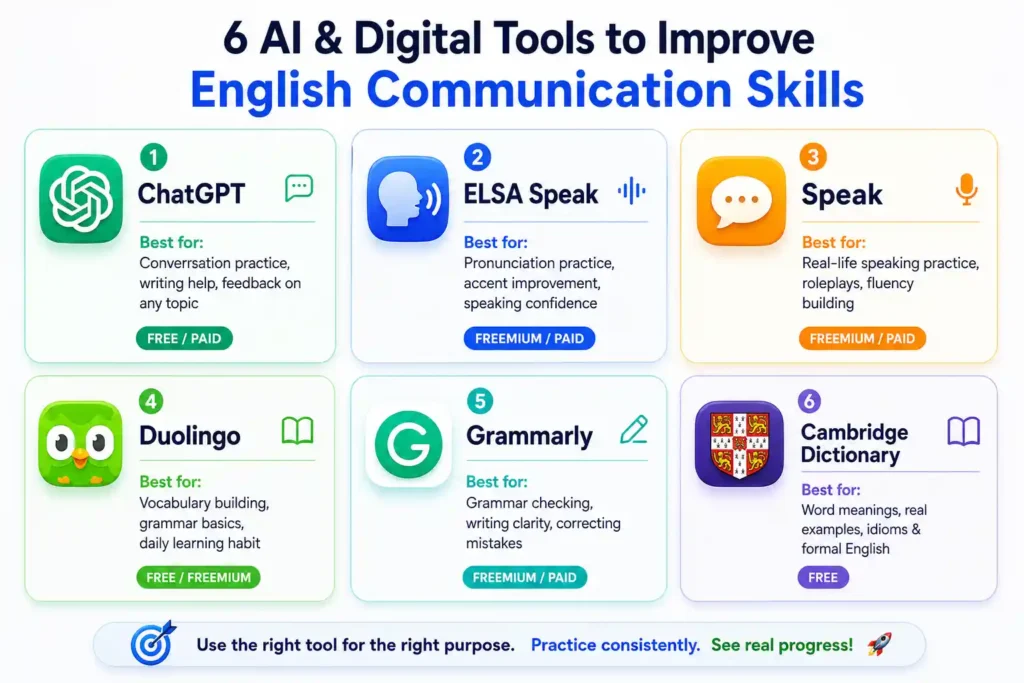
The best choice depends on your specific problem: conversation practice → ChatGPT Voice; pronunciation → ELSA Speak; structured speaking lessons → Speak; beginner English → Duolingo; writing and grammar → Grammarly + ChatGPT; pronunciation reference → Cambridge Dictionary.
Quick Answer
Best AI Tools for Learning English Communication Skills
| Your bottleneck | Use this |
| 🗣️ You freeze or go blank mid-conversation | ChatGPT (Voice) |
| 🎯 People ask you to repeat yourself | ELSA Speak |
| 📚 You want a fixed lesson sequence, not open chat | Speak |
| 🌱 You’re a true beginner needing daily structure | Duolingo |
| ✍️ Your writing has grammar errors | Grammarly + ChatGPT |
| 🔊 You need to double-check a word’s pronunciation | Cambridge Dictionary |
| 💼 You have an interview or presentation coming up | ChatGPT role-play |
What Is the Best Way to Improve English Communication Skills With AI?
The most effective way to improve English communication skills with AI is to practise realistic conversations, identify recurring mistakes, correct them, and use the improved language in real situations. ChatGPT Voice is a flexible starting point for conversation practice, interview simulations, vocabulary development, and workplace scenarios. ELSA Speak is worth considering when pronunciation feedback is the main priority, while structured language-learning apps can help beginners build a regular practice habit.
The right tool depends on what you need to improve. If you understand English but struggle to respond quickly, practise unscripted speaking. If people frequently misunderstand particular words, focus on pronunciation and clarity. If your emails sound unnatural, use an AI writing assistant to review tone, grammar, and sentence structure.
A practical starting routine is to spend 10–15 minutes a day speaking aloud, reviewing a small number of recurring errors, and repeating the corrected sentences. Once a week, test the same skill with a real person. AI can provide additional practice and feedback, but real conversations remain important for developing listening skills, adaptability, and confidence.Don’t waste hours jumping between AI tools that barely help—discover these powerful AI tools for students in India that can make studying, assignments, and exam prep much easier.
You do not need several paid subscriptions to begin. Start with one suitable tool, establish a consistent routine, and add another only when you identify a specific limitation that your current approach cannot address.
No single tool covers every part of this well, and you don’t need all six at once — the section on avoiding tool overload below explains how to add tools one at a time, only when a real gap shows up.
Many students struggle because they do not have a structured study schedule. If that sounds familiar, check out AI Tools for Creating a Study Timetable Automatically: 9 Powerful and Smart Solutions for Students in 2026 to learn how AI can create a personalized timetable in just a few minutes.
🚦 Before You Add Another AI English Tool: Use the Red–Yellow–Green Test
Not every English problem needs another app. Sometimes the better move is to change how you are practising with the tool you already have.
🟢 Green — Keep your current tool
Your practice is consistent, you know what skill you are working on, and you can see small changes in real conversations. Don’t add another app just because a new one has a better-looking feature list.
🟡 Yellow — Change the method first
You are practising regularly, but the same problem keeps appearing. Before paying for another tool, change the exercise. If you always practise prepared answers, try unscripted questions. If you always type, switch to voice. If you always ask for immediate corrections, try delayed feedback.
🔴 Red — Change the tool or add human practice
You have used the tool consistently for several weeks, measured the same problem repeatedly, and there is still no meaningful improvement. That is when a specialised tool, teacher, speaking partner, or real-world practice may make more sense.
The rule: don’t solve a practice-method problem by buying another app.
If you are looking for free AI resources, do not miss Best AI Tools for Students Free in 2026: 10 Powerful Picks to Study Faster and Smarter, which features some of the most useful no-cost tools available for students.
Knowing English Isn’t the Same Skill as Communicating in It
This is worth separating clearly, because it changes which AI tool for learning English communication skills actually helps you.
Language knowledge is what grammar classes and vocabulary lists build: rules, word meanings, sentence structures stored in memory.
Communication performance is what happens live, under time pressure, in front of another person: retrieving the right word in under a second, adjusting mid-sentence when you realize you’ve made an error, tracking what the other person just said while planning your reply, and doing all of this while managing nervousness.
You can max out the first and still struggle with the second. That gap is exactly why someone can score 8/10 on a written grammar test and still stumble through a two-minute self-introduction.
A 90-Second Test to Find Your Real Bottleneck
Record yourself explaining your weekend in English for 90 seconds, without stopping to think. If you can write the same explanation on paper without major errors but the spoken version is full of pauses and restarts, your issue is performance, not knowledge — and that changes which tool below is actually worth your time first.

Which AI English Learning Tool Fits Your Specific Problem?
🧊 If you freeze when speaking
This is usually a retrieval-speed problem, not a vocabulary gap — under pressure, you can’t access words you actually know.
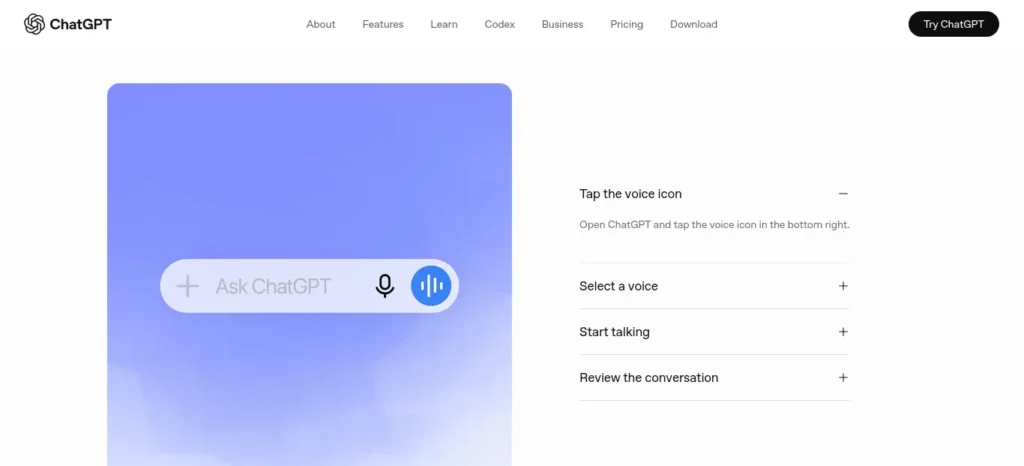
ChatGPT Voice is the best fit because you can run the same scenario repeatedly with zero social cost for messing up, which is exactly the repetition retrieval speed needs.
👂 If people ask you to repeat yourself
Don’t assume this means “bad accent” — it usually means specific sounds are unclear, not your accent as a whole.
ELSA Speak analyzes your recorded speech sound by sound and tells you which 2–3 recurring sounds are actually causing the confusion, rather than vague “work on your pronunciation” feedback.
📝 If your grammar is weak in speech but not writing
This split is common and tells you something: you know the rule but haven’t automated it.
Use ChatGPT to get the rule explained in plain language, then say the corrected sentence out loud five times — reading a grammar explanation doesn’t fix spoken grammar, repetition does.
🧠 If you understand words but can’t produce them
This is a passive-vocabulary problem — you recognize the word when you hear it but can’t retrieve it when you need it.
Ask ChatGPT to use 5–10 target words inside a conversation about a topic you care about, then try to reuse each word yourself within the same conversation.
🌱 If you’re a complete beginner
Start with Duolingo for basic sentence structure and daily habit-building before attempting open conversation — trying to have a free-form AI conversation with near-zero vocabulary usually causes more frustration than progress.
💼 If you need interview or presentation practice
Use ChatGPT role-play with your actual resume or presentation topic fed in, and ask it to behave like a real interviewer who asks follow-ups based on what you just said — not a fixed script of generic questions.
🏢 If you need workplace English specifically
Combine ChatGPT for email drafting, meeting phrases, and situational role-play with ELSA Speak if pronunciation clarity — not vocabulary — is what’s undermining you in meetings.
Before you start writing your assignment, it’s important to know how to use AI for college research projects effectively. A strong research process helps you find credible sources, organize ideas, and avoid common mistakes that can lower your grades.

How to Use AI to Improve English Work Messages
AI writing assistants can help employees make work messages clearer, more polite, and easier to understand. The most useful approach is to provide the original message, explain the intended tone, and ask the AI to preserve the facts and meaning.Stop wasting time on repetitive tasks—discover the best AI tools for everyday tasks that can help you work smarter, simplify daily routines, and get more done with less effort.
Step 1: Write Your Original Message
Start with the message you would naturally write. Do not worry about making every sentence perfect.
Example:
“Hi sir, I cannot complete the report today because some data is missing. I will send tomorrow.”
Step 2: Ask AI to Improve Clarity and Tone
Use this prompt:
“Rewrite the following workplace message in clear, natural professional English. Keep it polite and direct. Preserve my original meaning and do not invent details or promises. Give me one improved version and briefly explain the important changes.
Original message: [Paste your message here]”
Step 3: Review the Suggested Version
A possible revision is:
“Hi, I won’t be able to complete the report today because some data is still missing. I expect to send it tomorrow.”
Only use “I expect to send it tomorrow” if that accurately reflects your situation. If you cannot confidently commit to that timeline, ask the AI for a version that communicates the delay without making an unsupported promise.
Step 4: Learn From the Correction
Ask the AI:
“Explain the three most important improvements in my original message. Show me how to make similar sentences clearer next time. Give me two short practice exercises, but do not write an entirely new message for me.”
This step turns editing into a learning opportunity rather than making the AI responsible for every message you write.
Step 5: Check Before Sending
Read the final message yourself. Verify names, dates, deadlines, attachments, commitments, and the intended tone. An AI-generated message can sound polished while still containing an incorrect detail or an unintended promise.
What About Messages to International Colleagues?
Use plain, specific language when communicating across teams and language backgrounds. Avoid unnecessary idioms, ambiguous expressions, and overly complicated sentences.
For example, instead of writing “Let’s touch base when you get a chance,” you could write “Could we discuss the project update this afternoon?”
Neither expression is inherently wrong. The second is simply more explicit when the timing and purpose of the conversation matter.
AI can help you practise these differences, but your final message should reflect your workplace culture, relationship with the recipient, and actual intention.
How AI-Based English Practice Actually Works
(With a Real Example)
Skip the theory for a second and look at what one AI-assisted practice session looks like in practice.
Say your problem is that you go quiet during group discussions because you can’t form an opinion fast enough. Here’s the loop:
- You attempt it. You ask ChatGPT to run a 3-minute group-discussion-style debate on a neutral topic (“Should colleges make attendance optional?”) and give your opinion out loud.
- You get specific feedback, not “good job” — something like: “You used ‘I think’ six times in ninety seconds. Try starting two of your points with ‘The way I see it’ or ‘From my perspective’ instead.”
- You correct it immediately — same topic, same 3 minutes, but this time you consciously vary your sentence openers.
- You repeat with a new topic the next day, applying the same fix until it’s automatic.
- You test it with a real person — a friend, a study group, or an actual GD — because that’s the only way to know if the fix survived contact with an unscripted conversation.
Step 5 is the one people skip, and it’s the single biggest reason someone can practice with AI for two months and still feel unprepared in a real room. AI builds the reps. Only a real conversation tells you if the rep transferred.
🧰 The English Practice Toolbox: Match the Tool to the Job

Think of AI English tools less like competing apps and more like different tools in a toolbox. You would not use a screwdriver to hammer a nail, and the same idea applies here.
| Your immediate task | Best type of tool | What you should produce |
|---|---|---|
| Start speaking without freezing | AI voice conversation | A 1–2 minute unscripted answer |
| Fix recurring pronunciation problems | Speech-analysis tool | A shorter list of sounds to practise |
| Build basic English habits | Structured learning app | Completed lessons + spoken repetition |
| Prepare for an interview | AI role-play | Answers to unexpected follow-up questions |
| Improve workplace writing | Grammar/writing assistant | A clearer real email or message |
| Check how a word should sound | Pronunciation dictionary | One verified pronunciation target |
| Test whether practice transferred | Real person | An unscripted conversation |
The important column is the last one: what you should produce. An app lesson, streak, score, or completed exercise is only useful if it eventually changes what you can do without the app.
The 6 Best AI Tools for Learning English Communication Skills
💬 ChatGPT
Best for
Open-ended conversation, role-play, grammar explanations, interview prep.
ChatGPT’s Voice feature supports live back-and-forth spoken conversation, and Study Mode is built around guided questions and step-by-step explanations rather than just handing you a finished answer — genuinely useful when you want to understand why a sentence is wrong, not just that it is.
How to use it well
Don’t just say “help me practice English” — that produces generic small talk. Give it a specific role (“act as a strict but fair interviewer for a customer support role”), a specific correction rule (“only correct me after I finish speaking, not mid-sentence”), and a specific duration (“run this for 3 minutes, then give feedback”).
Free option
Yes. ChatGPT Free supports conversational use with usage limits that can tighten during high-demand periods.
In India, ChatGPT Go is officially priced at ₹399/month,
and ChatGPT Plus runs roughly ₹1,999/month (~$20 USD) — though a small number of pricing trackers cite Plus closer to ₹1,499/month in India,
so this is one figure worth confirming in-app at checkout rather than trusting any single source, including this one.
Honest limitation
ChatGPT isn’t a dedicated speech-analysis engine. It can miss pronunciation issues entirely if your words are intelligible enough for its speech recognition to parse, even if a human listener would still find your pronunciation unclear.
Skip it if
You’re a true beginner who doesn’t yet have enough vocabulary to sustain even a simple exchange. Start with Duolingo instead.
Pair it with
ELSA Speak, for the pronunciation feedback ChatGPT can’t reliably give.
🎯 ELSA Speak
Best for
Pronunciation and speech-clarity feedback specifically.
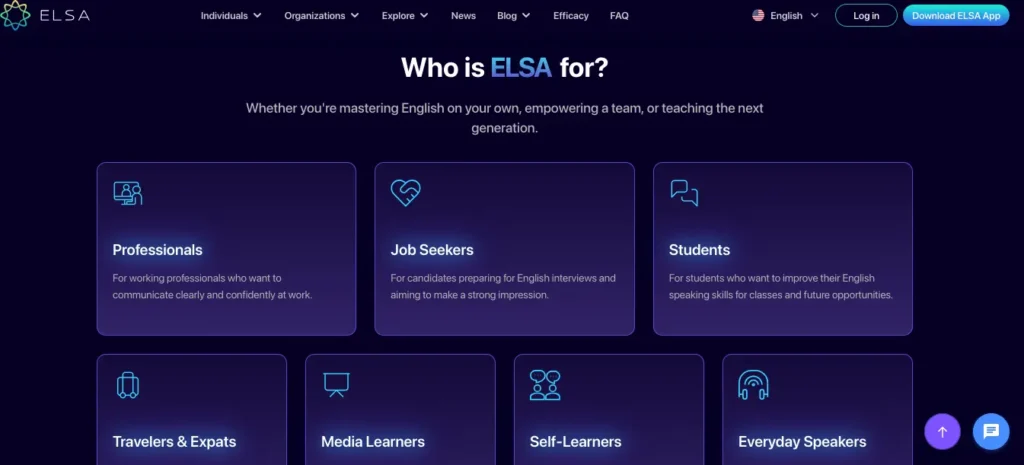
ELSA uses speech-recognition technology to score your recorded speech and flag which specific sounds are causing intelligibility problems, rather than giving you a vague overall impression.
How to use it well
Don’t try to fix every flagged sound at once. Record a 2-minute sample, note the 2–3 sounds that show up repeatedly across different words, and drill only those for a week before moving on.
One thing worth knowing
Independent reviewers note ELSA’s scoring can be strict even with native speakers and English teachers, who sometimes score 80% or lower on words they pronounce correctly. Treat the score as a directional signal, not a precise measurement.
Free option
A free tier with limited lessons exists, and most sources report a 7-day free trial on the paid plan.
Pricing conflict, unresolved: third-party trackers report ELSA Premium anywhere from roughly $12 to over $16 per month, with no single figure consistent across more than two sources. Confirm the live price inside the app before subscribing.
Skip it if
Grammar or vocabulary, not pronunciation, is your actual bottleneck.
Pair it with
Cambridge Dictionary, to verify the correct target sound for a specific word before drilling it in ELSA.
📚 Speak
Best for
A structured, video-led speaking curriculum for learners who want a fixed sequence rather than open chat.
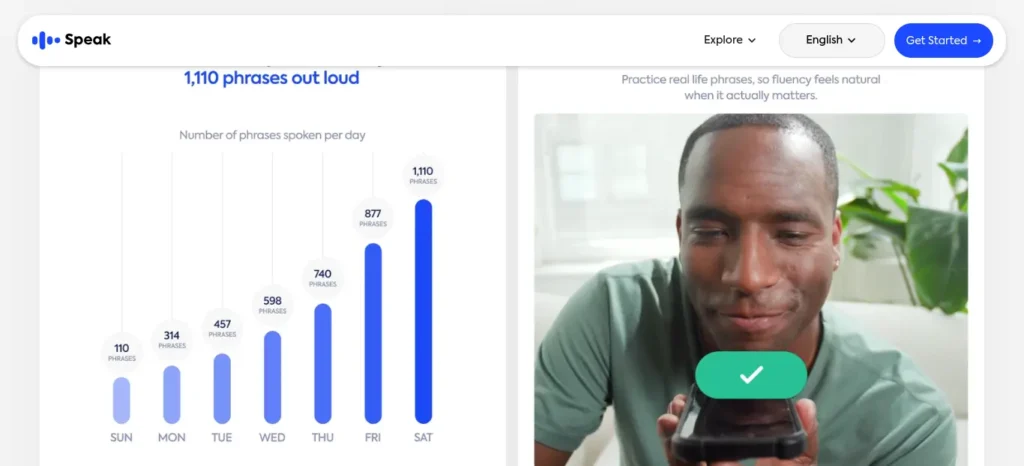
Speak runs on a Learn → Practice → Apply loop: you’re taught phrases, drilled until they’re automatic, then dropped into an AI conversation to use them. It’s backed by the OpenAI Startup Fund.
A limitation genuinely worth knowing before you pay
Three independent reviews — including a language-tutoring marketplace with no reason to favor either side — confirm that Speak’s English course currently offers only American-accented conversation practice, with no British, Australian, or Canadian option.
How to use it well
Work through units in order rather than skipping to “Free Talk” mode immediately — the structured drills exist specifically to make phrases automatic before open conversation asks you to retrieve them under pressure.
Dedicated AI Tutor vs ChatGPT for English Practice
A dedicated AI tutor app and ChatGPT can overlap, but they are not necessarily designed around the same experience.
A dedicated English-learning app may give you a more focused learning environment, pronunciation exercises, structured lessons, progress tracking, or activities built specifically for language learners. ChatGPT is more flexible: you can use it for conversation role-play, interview practice, explanations, vocabulary work, writing feedback, and customized speaking exercises in the same conversation.
For many learners, the practical question is not which type of tool is universally better. It is which type of practice they will actually use consistently.
If your main need is flexible conversation practice and customized scenarios, ChatGPT can be a useful starting point. If you want a structured language-learning experience with dedicated speaking or pronunciation exercises, a specialized AI tutor may fit your workflow better.
Whichever option you choose, test it against a specific goal—such as speaking for five minutes without switching to your native language, improving pronunciation of difficult words, or preparing for an interview—rather than choosing an app simply because it has more AI features.
Free option
A 7-day free trial, but no lasting free daily-use tier.
Pricing conflict, unresolved: reported monthly pricing ranges from roughly $18 to $30, and annual pricing from roughly $84 to $180 depending on source and promotion.
Skip it if
A lasting free option matters to you, or accent variety matters for your specific goal.
Pair it with
ChatGPT, for open-ended practice once you’ve outgrown Speak’s scripted scenarios, or for accent variety Speak doesn’t offer.
Is a Dedicated AI English Tutor Better Than ChatGPT Study Mode?
A dedicated AI English tutor and ChatGPT Study Mode serve different purposes, so neither is automatically better for every learner.
ChatGPT Study Mode is designed to support guided learning through questions, explanations, and step-by-step exploration. ChatGPT Voice is the more directly relevant feature when your goal is to practise spoken conversations. A dedicated English-learning app may provide a more structured course, targeted pronunciation exercises, or language-specific learning activities, depending on the product.AI can save you hours on assignments, but only if you know where to use it—and where to stop; learn how to use AI for college research projects the smarter way.
Use the following decision guide:
- Choose ChatGPT Study Mode when you want to understand grammar rules, explore why a sentence is incorrect, or work through a language-learning problem step by step.
- Choose ChatGPT Voice when you want to practise answering questions aloud, simulate an interview, or rehearse an everyday conversation.
- Consider a dedicated pronunciation tool when you need detailed feedback on particular sounds, stress, or intonation.
- Consider a structured English-learning app when you prefer a guided curriculum over designing your own practice sessions.
For example, a learner who repeatedly confuses past-tense forms could use Study Mode to understand the grammar, then use Voice to practise answering questions about yesterday’s activities. If a particular word remains difficult to pronounce, a dedicated pronunciation tool may provide more targeted feedback.
Before paying for a separate app, identify the feature you are missing. If you already practise speaking consistently and your main difficulty is pronunciation, a specialist tool may be worth trying. If you rarely practise, changing your routine may be more useful than purchasing another subscription.
Check the current features and pricing of each product before deciding. Study Mode, Voice, and dedicated tutor apps are not interchangeable, and their availability, limits, and capabilities can change.
🌱 Duolingo
Best for
Complete beginners who need structure and a daily habit before anything else.
The core app is free, gamified, and genuinely effective for building consistency — the habit-formation design is arguably Duolingo’s strongest feature, more than any single lesson.
A gap worth flagging specifically for Indian learners
Duolingo’s AI conversation features — Video Call and Roleplay, bundled under Duolingo Max — are documented as available for English speakers learning languages like Spanish, French, German, Japanese, or Korean. We found no confirmed evidence that these AI conversation features exist on Duolingo’s English-for-Hindi-speakers or English-for-Tamil-speakers courses. Check inside the app before paying for Max on this basis.
Known limitation
Multiple independent reviews describe a pattern where Duolingo builds recognition (understanding language you hear or read) faster than production (generating it yourself). Most learners plateau at a level where they understand far more than they can say.
Free option
Yes, with ads and a daily energy limit on mobile (the desktop web version currently has no energy cap). Paid tiers — Super Duolingo and Duolingo Max — carry pricing that varies meaningfully across sources and regions.
Skip it if
You’re past absolute-beginner level — Duolingo adds little once you can already form basic sentences.
Pair it with
ChatGPT or ELSA Speak, once you’ve outgrown Duolingo’s beginner ceiling.
Before you start writing your assignment, it’s important to know how to use AI for college research projects effectively. A strong research process helps you find credible sources, organize ideas, and avoid common mistakes that can lower your grades.
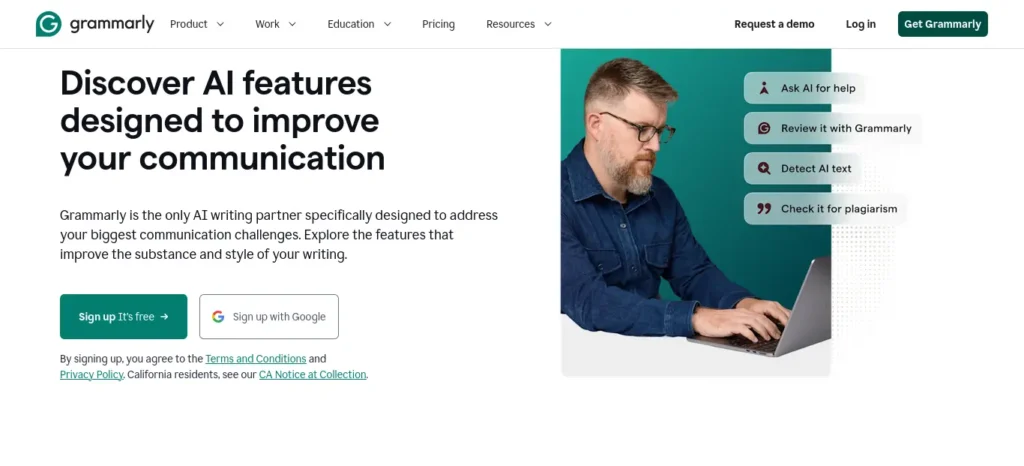
✍️ Grammarly
Best for
Grammar accuracy and clarity in writing — not speaking, and not fluency.
This is worth stating plainly because it’s a common mistake: Grammarly is a writing tool. It checks emails, assignments, and messages. It does nothing for pronunciation, listening, or spontaneous spoken conversation.
How to use it well
Install the browser extension and let it check writing you’re already doing — internship emails, assignment drafts, LinkedIn messages — rather than treating it as a separate practice exercise.
Free option
Yes. Grammarly’s free plan covers real-time grammar and spelling checks plus a capped number of monthly AI prompts (100/month as of this writing). Grammarly Pro is $12/month on annual billing (roughly ₹1,150/month at current approximate conversion) or $30/month billed monthly — this pricing was consistent across every source checked.
Skip it if
Speaking, not writing, is your priority.
Pair it with
ChatGPT, for spoken practice and for explaining why a grammar rule Grammarly flagged works the way it does.
🔊 Cambridge Dictionary
Best for
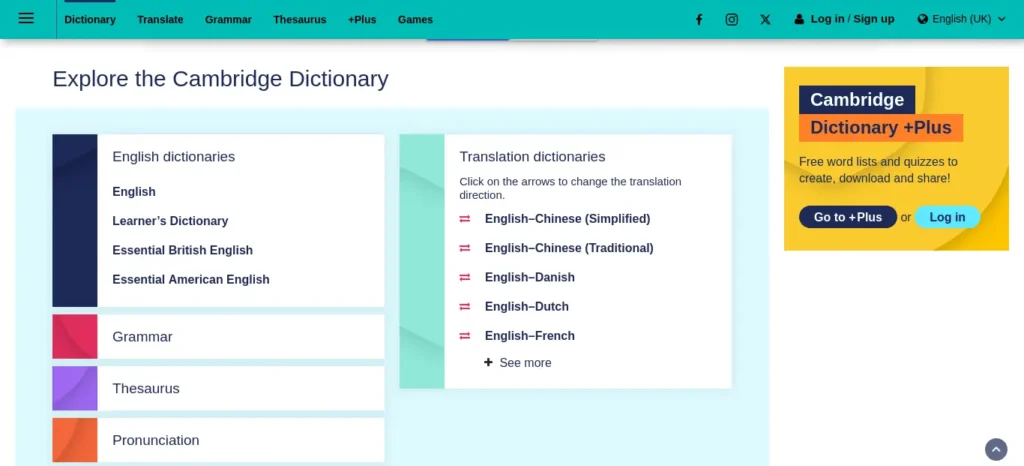
Verifying a specific word’s meaning or pronunciation — a reference, not a practice tool.
Cambridge Dictionary provides UK and US pronunciation audio alongside phonetic (IPA) transcription for individual words.
How to use it well
When a tool flags a mispronounced word, look it up here, listen to both UK and US audio, decide which target you’re aiming for, and go back to ELSA to drill that specific sound.
Free option
Yes, fully free.
Skip it if
Never — it costs nothing and has no real downside as a companion reference.
Pair it with
Everything else on this list. It’s the one tool here with no direct competitor for its specific job.
How to Use ChatGPT as an AI English Speaking Partner
Copy and adapt these directly — the specificity in the prompt is what makes the difference, not the topic.
Beginner conversation
“Talk to me in simple English about my daily routine. Ask me one question at a time. Correct my grammar only after I finish my full answer, not while I’m speaking.”
Intermediate conversation
“Have a natural conversation with me about [topic]. Push back on my opinions like a real person would, and ask follow-up questions instead of moving on immediately.”
Interview practice
“Act as an HR interviewer for a [specific role] position. Ask common interview questions one at a time, including unexpected follow-ups based on my answers. Give feedback only at the end, not during.”
Workplace English
“I need to sound professional in a team meeting. Roleplay a meeting where I have to disagree politely with a colleague’s idea. Tell me if my tone sounds too blunt or too passive.”
Post-conversation correction
“Point out every grammar mistake I made in this conversation, explain why each one is wrong in one sentence, and give me the corrected version of each.”
Pronunciation awareness
“Based on this conversation, list words that Indian English speakers commonly pronounce differently from the standard, and explain the difference simply — don’t just say ‘wrong,’ explain what changes.”
Uninterrupted practice
“Let me speak for 2 minutes without any correction. Just listen and respond naturally like a real conversation partner would.”
Delayed feedback
“Have a full 5-minute conversation with me first, staying fully in character. Only after it ends, give me a structured list of grammar, vocabulary, and fluency issues.”
Most students use AI as a simple chatbot, but the real advantage comes from following a complete workflow. Discover our AI study workflow for students and learn how to capture notes, create quizzes, schedule revision, and prepare for exams more effectively.
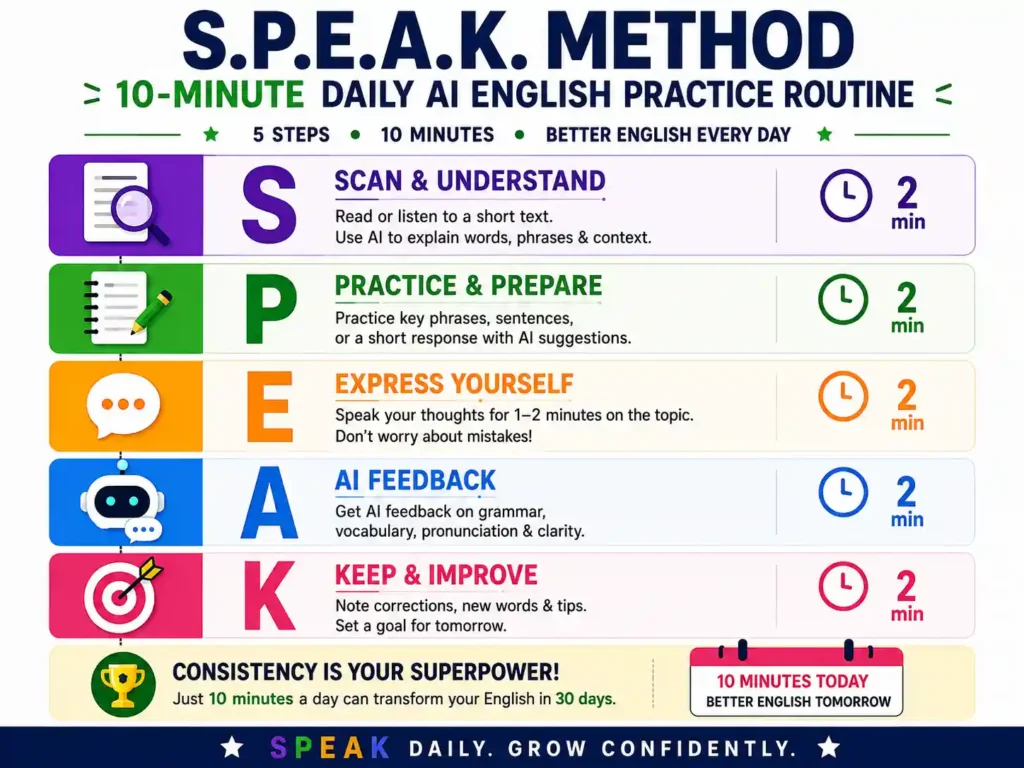
A 10-Minute Daily AI English Practice Routine: The S.P.E.A.K. Method
An original framework for turning scattered app use into one repeatable daily system, rather than five separate habits competing for your attention.
S — Speak (2 minutes)
Talk to ChatGPT Voice or Speak about anything — no topic prep, no aiming for perfection.
P — Practice (2 minutes)
Run the same topic through ELSA Speak, focused on words you stumbled over during the first two minutes.
E — Examine mistakes (2 minutes)
Ask ChatGPT to list exactly what went wrong — grammar, word choice, or pronunciation, one line each.
A — Apply corrections (2 minutes)
Say each corrected sentence out loud three times, until it feels automatic rather than something you’re translating in your head.
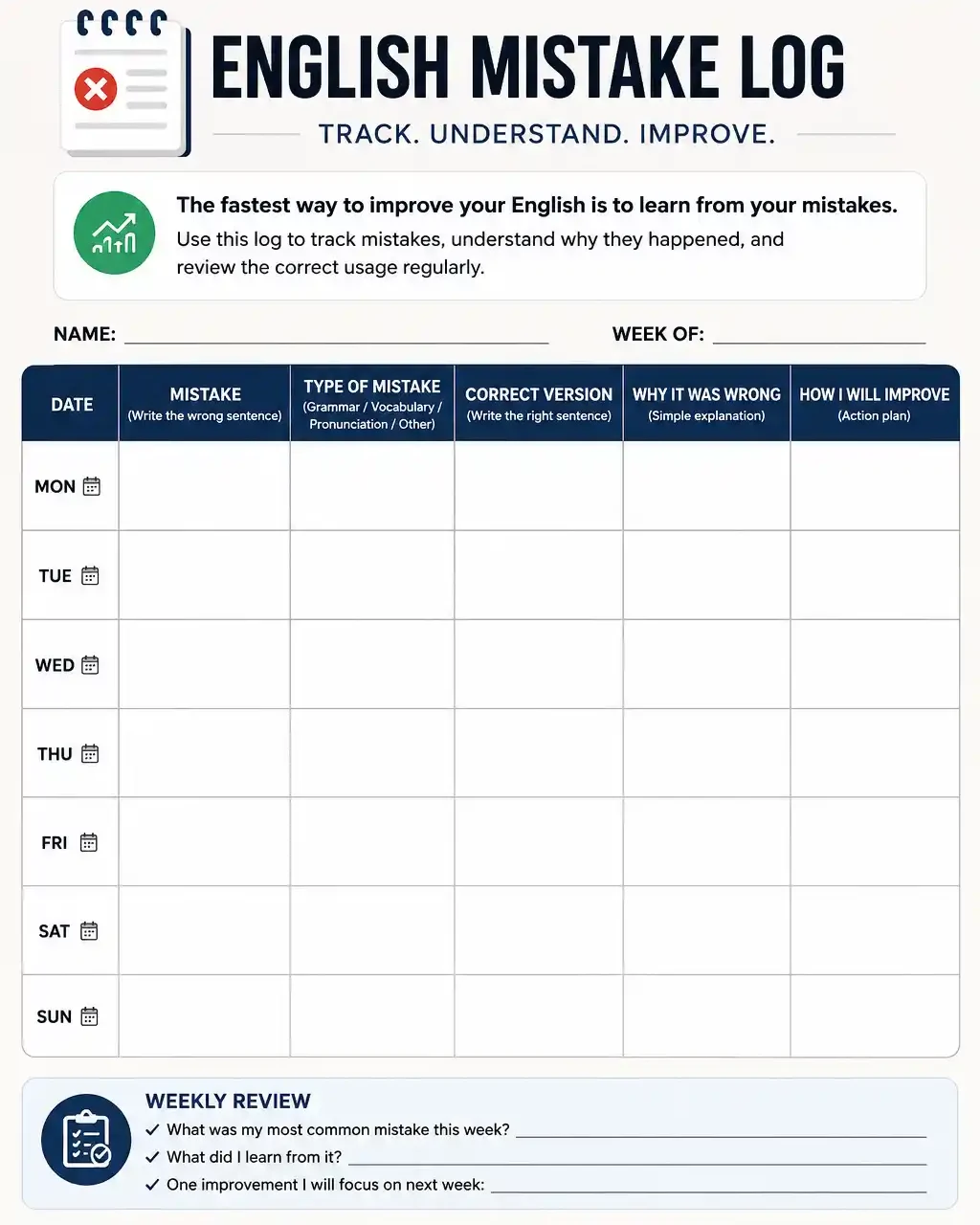
K — Keep a mistake log (2 minutes)
Write down the 1–2 errors that repeated, not everything — a log with 40 entries gets ignored; one with 5 recurring patterns gets fixed.
How to Plan an Effective Routine for Learning English Using AI Tools
An effective English-learning routine should combine speaking, listening, vocabulary retrieval, correction, and real-world practice. Instead of using every AI feature each day, assign a clear purpose to each practice session and review your progress at the end of the week.
For most beginners and intermediate learners, a short daily session is easier to maintain than an ambitious schedule that quickly becomes difficult to follow. The exact amount of practice needed depends on your current level, available time, and learning goals.If you’re a final-year student struggling with research, assignments, or project work, don’t let AI make the process more confusing—see how to use AI tools effectively for college research projects and turn scattered information into a clear, credible workflow.
A Practical 7-Day AI English Practice Plan
Day 1: Everyday conversation
Choose a familiar topic, such as your daily routine, studies, hobbies, or weekend plans. Speak for two minutes without writing a script first. Ask an AI conversation partner to identify your three most important mistakes after you finish.
Example prompt:
“Act as a friendly English conversation partner. Ask me one question at a time about my daily routine. Let me answer in my own words. Do not interrupt me to correct every sentence. At the end, identify three important grammar or vocabulary problems and give me natural alternatives.”
Day 2: Vocabulary you can actually use
Choose five useful words or expressions related to your studies or work. Ask the AI to use them in a realistic conversation, then answer questions that require you to use those expressions yourself.
For example, practise phrases such as “I would like to clarify,” “From my perspective,” and “Could you explain that again?” Use each phrase in a complete sentence rather than memorising a definition alone.
Day 3: Pronunciation and listening
Choose a short passage or a few sentences that contain words you often mispronounce. Listen to a reliable pronunciation reference, repeat the sentences aloud, and use a dedicated speech-feedback tool if available.
Cambridge Dictionary provides UK and US pronunciation audio and phonetic transcriptions for many entries. This can help you compare pronunciations before practising a difficult word repeatedly.
Day 4: Grammar in spoken English
Identify one recurring grammar problem from your mistake log. Ask the AI to explain the rule in simple language, give you five examples, and then ask you questions that require you to use the same structure in conversation.
For example, if you frequently say “I didn’t went,” practise the difference between “I went” and “I didn’t go.” The aim is to use the correct form while speaking, not simply recognise it in a written explanation.
Day 5: Workplace or academic communication
Practise a situation that matters to your current goals. Students might rehearse asking a professor for clarification or presenting an assignment. Job seekers might practise introducing themselves, answering interview questions, or explaining a project.
Ask the AI to include unexpected follow-up questions. This helps you practise responding to new information instead of memorising a single perfect answer.
Day 6: Unscripted conversation
Choose a topic you have not prepared in advance. Speak for three to five minutes, allow the AI to ask follow-up questions, and avoid reading prepared sentences.
Record recurring problems rather than correcting every minor mistake. If your main difficulty is long pauses, focus on completing your thoughts. If it is grammar, track the particular structure you repeatedly misuse.
Day 7: Review and real-world practice
Review your mistake log and compare your performance with an earlier recording. Then have a short conversation with a classmate, friend, teacher, colleague, or language partner.
Notice whether you can retrieve words more quickly, explain your ideas more clearly, and respond to unexpected questions. If the same problem remains, change the exercise or seek more specific feedback rather than automatically buying another app.
How to Adjust the Routine to Your English Level
For beginners: Spend more time on common vocabulary, basic sentence patterns, listening, and short guided conversations. Ask the AI to use simple English and explain unfamiliar words.
For intermediate learners: Focus on spontaneous answers, follow-up questions, explaining opinions, and correcting recurring grammar errors. Gradually reduce the amount of preparation before speaking.
For advanced learners: Practise professional presentations, negotiation, disagreement, detailed explanations, and discussions involving unfamiliar topics. Work on precision, tone, clarity, and adapting your message to different audiences.
How Do You Know Whether the Routine Is Working?
Track a small number of indicators rather than relying entirely on an app’s score or daily streak. You could measure how long you can speak without stopping, how frequently the same grammar errors occur, how many target expressions you use naturally, and whether listeners understand you without repeated clarification.
Compare recordings made under reasonably similar conditions every two to four weeks. One unusually good or bad session is not enough to establish progress.
The key principle is simple: a useful routine should gradually improve what you can do independently, outside the AI application.
Example mistake log — the format that actually gets used:
| Date | Mistake | Corrected | Why |
| Aug 12 | “I didn’t went” | “I didn’t go” | Did + base verb, not past tense |
| Aug 13 | “I am agree” | “I agree” | “Agree” is already a verb — no “am” needed |
| Aug 15 | “Since 2 years” | “For 2 years” | Since + a point in time; for + a duration |
Three columns, one line each, updated daily. The value isn’t in the log itself — it’s in reviewing it weekly and noticing the same mistake appearing four times in a row, which tells you exactly what to drill next instead of guessing.
How to Improve English Communication Skills With AI
AI can make English communication practice easier when you use it as a practice partner rather than as a replacement for real conversations.
A simple approach is to choose one communication problem at a time. If you struggle to speak without pausing, use an AI voice tool for short conversations. If pronunciation is your main problem, use pronunciation feedback and repeat the same difficult words or sentences. If you know what you want to say but cannot form sentences quickly, ask an AI tutor to role-play everyday situations and respond to your answers.
For example, you can practice a five-minute conversation about introducing yourself, asking a professor a question, attending a job interview, or participating in a group discussion. After the conversation, ask the AI to identify your three most important problems and give you a short exercise for each one.
The goal is not to have AI speak for you. The goal is to use repeated AI practice to make real English conversations feel more familiar. After practicing with AI, try using the same expressions with a real person, in class, at work, or in another everyday situation.
How to Use AI to Improve English Speaking Skills
The most effective way to use AI for English speaking is to treat it as a practice partner, not a replacement for communication.
Start with a short voice conversation instead of typing. Choose one realistic situation, such as a job interview, classroom discussion, presentation, customer conversation, or casual introduction. Speak without preparing every sentence, then ask the AI to identify only your three most important problems.
Use this simple cycle:
- Speak for 2–3 minutes without stopping.
- Review your biggest grammar, vocabulary, or pronunciation problems.
- Correct one recurring mistake.
- Repeat the same situation using the correction.
- Test the skill with a real person.
This works better than asking an AI tool to “make my English better” because you are practising a specific communication behaviour and measuring whether it improves.
How to Choose the Right AI English Learning Tool Without Overpaying
The free-first sequence
- Start with ChatGPT. Free, flexible, and covers conversation, grammar explanation, and vocabulary in one place — there’s no reason to pay for anything else in week one.
- Practice consistently for 2–3 weeks before deciding you need a specialized tool. Most people can’t yet tell what their real bottleneck is after three days.
- Add exactly one specialized tool only if a specific, persistent gap remains — pronunciation that ChatGPT can’t fix (add ELSA), or a need for imposed structure because open chat feels directionless (add Speak or Duolingo, depending on your level).
Best Free AI Tools to Improve English Communication Skills
You can begin improving English communication skills without paying for a dedicated AI tutor. The best free option depends on whether you need conversation practice, pronunciation references, grammar feedback, or structured lessons. Check the current free-plan limits before building your routine around any one application.If you’re a final-year student struggling with research, assignments, or project work, don’t let AI make the process more confusing—see how to use AI tools effectively for college research projects and turn scattered information into a clear, credible workflow.
1. ChatGPT Free for Conversation and Grammar Practice
ChatGPT can help you practise everyday conversations, generate follow-up questions, explain grammar, build vocabulary exercises, and rehearse interviews. Voice availability and usage limits may depend on the current plan and product conditions.
Start with one realistic scenario, such as introducing yourself or explaining a college project. Speak aloud, review the feedback, and repeat the task with one improvement.
Official information: https://help.openai.com/en/articles/20001274-chatgpt-voice
2. Cambridge Dictionary for Pronunciation References
Cambridge Dictionary provides pronunciation audio and phonetic transcriptions for many English words, including UK and US pronunciations. It is a useful reference when you want to check how a particular word is pronounced.
For example, look up a word you frequently mispronounce, listen to the available audio, and repeat it in a complete sentence. A dictionary can help you check a pronunciation, but it does not replace a conversation partner or a structured speaking course.
Official information: https://dictionary.cambridge.org/help/phonetics.html
3. Grammarly Free for Written English
Grammarly’s free plan offers writing assistance, including grammar and spelling support, subject to its current features and limits. It is useful for checking internship emails, messages, and assignment drafts.
It should not be treated as a substitute for spoken conversation practice. If speaking is your main goal, spend more time answering questions aloud than polishing written sentences.
Official information: https://www.grammarly.com/plans
4. Duolingo for Structured Beginner Practice
Duolingo may be useful if you need guided lessons and a regular learning habit. Its suitability depends on your current level, language course, and learning goals.
Before paying for a premium plan, verify that the specific course and conversation features you want are available for your language pair and region. Do not assume that every AI speaking feature is available in every English-learning course.
Official website: https://www.duolingo.com/
How to Build a Free English-Learning Routine
Start with one conversation session, use a reliable dictionary to check difficult words, and keep a short list of recurring errors. Add a writing assistant if written communication is also a priority.
For example, a college student could practise an interview answer with ChatGPT, check two difficult words in Cambridge Dictionary, and record the corrected answer in a notebook. A working professional could rehearse a meeting explanation and use a writing assistant to review the follow-up email.
A free tool is sufficient for getting started if it meets your needs. Consider paying only when you have identified a specific limitation, such as a feature you need regularly or a structured learning path that your existing routine does not provide.
A 3-Question Test Before You Pay for Anything
Ask yourself these before subscribing to a second or third tool:
- Has this specific problem shown up in my mistake log at least 5 times in two weeks?
- Have I actually used the free tier consistently, or am I hoping a paid tool will fix an inconsistency problem money can’t solve?
- Would a free alternative (Cambridge Dictionary for pronunciation checks, ChatGPT’s free tier for grammar explanations) realistically cover 80% of what I need?
If the answer to #2 is “I haven’t been consistent,” no paid tool fixes that.
✅ Stay Free If
Stay on a free plan if you only need occasional, self-directed English speaking practice and don’t need a structured course.
A free tool is usually enough if your main goal is casual conversation, basic grammar help, or vocabulary practice.
You can also stay free if you don’t need detailed progress tracking or personalised pronunciation scores.
If you’re still testing whether you can maintain a daily English practice routine, don’t pay for a premium app yet.
💳 Consider Paying If
Consider paying when you learn better with a structured course instead of open-ended AI conversations.
A paid tool may be worth it if you need detailed, sound-by-sound pronunciation feedback that general AI tools cannot provide reliably.
You may also benefit from a premium plan if you want progress tracking that shows how your performance changes over several weeks or months.
Paying makes more sense when you regularly hit the free plan’s limits during genuine practice sessions rather than occasionally reaching a usage cap.
Most importantly, consider upgrading only after you’ve practised consistently for at least three weeks and identified a specific weakness that your current tool isn’t helping you fix.
💡 Don’t pay to solve an inconsistency problem. Pay when you’ve already built the habit and a specific limitation is holding you back.
Can AI Really Make You Fluent in English?
Short answer: it can meaningfully accelerate practice, but it isn’t a substitute for real conversation, and treating it as one is where most learners plateau.
This isn’t just an opinion. A 2025 systematic review published in ScienceDirect synthesizing 30 empirical studies on AI-driven chatbots in second-language learning found a substantial positive impact on speaking fluency, learner motivation, and reduced anxiety — but the same review flagged real limitations: some studies reported increased anxiety in specific participants, and technical limits in speech recognition and contextual understanding remained a recurring barrier across the literature. A separate quasi-experimental study of 60 ESL learners in the Philippines found the group using an AI chatbot alongside regular classes showed significantly higher gains in speaking proficiency and willingness to communicate than the classroom-only group.
The Accent-Bias Nuance Most Guides Don’t Mention
Research on AI chatbots and EFL learners’ oral proficiency has noted that these systems tend to model “commonly accepted American English pronunciation,” which means AI tools train you toward one specific accent standard by default — worth knowing if your actual goal is understanding a wider range of English accents, including Indian English itself, British English, or the accents of international colleagues.
The practical takeaway: AI practice + authentic English input (shows, podcasts, real articles) + actual human conversation outperforms any one of these alone.
What AI Cannot Replace When Learning English Communication Skills
- Unpredictability. Real conversations don’t follow a script, interrupt you mid-sentence, or change subject abruptly the way AI role-play scenarios rarely do, even the well-designed ones.
- Cultural and situational nuance. Knowing when a joke lands, when silence is appropriate, or how directness is read differently in a boardroom versus a casual chat isn’t something correction prompts teach.
- An experienced teacher’s pattern recognition. A good teacher notices a mistake pattern across weeks of your work, not just within a single session.
- Social confidence built through real stakes. The specific nervousness of talking to an actual stranger, where a real reaction is possible, only fades through repeated real exposure.
- Accent range and situational listening. As the research above suggests, AI conversation defaults toward one accent standard. Understanding a colleague with a strong regional accent needs real-world listening practice AI role-play doesn’t fully simulate.
Which AI Tool Should You Use for English Communication?
The right AI communication tool depends on what is stopping you from communicating comfortably in English.
- Need conversation practice? Start with ChatGPT voice conversations.
- Need pronunciation feedback? Try ELSA Speak.
- Want structured speaking practice? Consider Speak.
- Need beginner-friendly vocabulary and lessons? Duolingo can provide a structured starting point.
- Mainly struggle with written grammar? Grammarly can help with editing and sentence clarity.
- Need to check pronunciation or word usage? Cambridge Dictionary is useful as a reference.
If you are not sure where to start, identify the one communication problem that affects you most and choose a tool specifically for that problem. You do not need six AI tools to improve your English. One tool used consistently for the right task can be more useful than constantly switching between apps.
→ The 3-Step Escalation Path: AI First, Humans Later
A useful way to think about AI English practice is as an escalation path rather than a permanent replacement for human interaction.
Step 1 — Practise privately.
Use AI to repeat the situation without embarrassment. Make mistakes, restart, ask questions, and experiment with different ways of expressing the same idea.
Step 2 — Add controlled pressure.
Remove some of the support. Stop reading prepared sentences, allow unexpected follow-up questions, limit your preparation time, and ask the AI to stay in character instead of helping you construct every answer.
Step 3 — Test it with a person.
Take the same skill into a real conversation. A classmate, friend, teacher, colleague, mentor, or interview partner can expose problems that an AI conversation may not reveal.
→ Private practice builds repetition. Controlled practice builds independence. Real conversation tests transfer.
If you repeatedly complete Step 1 but never reach Step 3, you may become very comfortable practising English without becoming equally comfortable using it with people.
Things Beginners Overlook About AI English Learning Apps
- Voice data and privacy. Speech-based apps like ELSA and ChatGPT Voice process your recorded voice on their servers. If privacy matters to you, check each app’s data policy before using voice features extensively.
- Dependency on constant correction. If every sentence gets corrected in real time, you never build the ability to self-monitor and fix your own errors mid-conversation.
- AI corrections aren’t infallible. Language models occasionally offer a “corrected” sentence that’s grammatically fine but unnatural, or miss a real error entirely. Cross-check anything that feels off.
- A learning curve exists, even for “simple” apps. Expect the first week with any new tool to feel less productive than week two or three. Don’t judge a tool’s usefulness from day one.
- Streaks and gamification aren’t the same as progress. A 400-day Duolingo streak measures consistency of opening the app, not fluency gained. Track the mistake log instead.
Common Mistakes When Using AI to Learn English
❌ 1. Staying in text mode when your goal is speaking.
Typing an answer gives you time to edit, translate, and think, but real conversations rarely give you that luxury. If speaking is your goal, move from typing to voice practice as early as possible.
❌ 2. Interrupting yourself for corrections after every sentence.
Constant correction can make you focus more on avoiding mistakes than expressing an idea. For fluency practice, finish your thought first and review the important errors afterward.
❌ 3. Collecting vocabulary instead of using it.
Saving twenty new words feels productive, but a word becomes useful only when you can retrieve it naturally. Choose a few words and deliberately use them in your next conversation.
❌ 4. Downloading multiple apps before building one habit.
Five English apps cannot compensate for five unfinished practice routines. Start with one tool, use it consistently, and add another only when you can identify a problem the first tool genuinely cannot solve.
❌ 5. Recording mistakes without ever reviewing them.
A mistake log is useful only when it changes what you practise next. Review your recurring errors each week and turn the most frequent one into a specific exercise.
❌ 6. Using AI as a permanent replacement for people.
AI gives you a safe place to practise, but real conversations introduce interruptions, unexpected reactions, different accents, and social pressure. Use AI to prepare for human interaction, not to avoid it.
❌ 7. Treating every AI correction as unquestionable.
AI can occasionally suggest wording that is technically correct but unnatural, or misunderstand what you were trying to say. When a correction feels strange, check it against a reliable dictionary, grammar reference, teacher, or another trusted source.
❌ 8. Trying to erase your accent instead of improving intelligibility.
Having an Indian, Tamil, Hindi, British, American, or other accent is not automatically a communication problem. Focus first on being understood clearly, especially on sounds or words that repeatedly cause listeners to ask you to repeat yourself.
❌ 9. Practising only inside your comfort zone.
If you always discuss familiar topics, you may become fluent at talking about the things you have already rehearsed. Occasionally practise unfamiliar topics, unexpected questions, disagreement, explanations, and situations where you have to think before answering.
💡 The bigger lesson
The goal isn’t to become perfect inside an AI app. It’s to become more capable outside it. If your practice sessions feel comfortable but real conversations still feel difficult, that’s a signal to change the practice conditions—not necessarily to download another app.
🎯 The One-Problem Rule: Don’t Try to Fix Your Entire English at Once
One of the easiest ways to make English practice ineffective is to ask an AI tool to improve everything simultaneously: grammar, vocabulary, pronunciation, confidence, fluency, sentence structure, accent, and speaking speed.
That creates too much feedback to use.
Instead, choose one communication problem for the week.
For example, if your current problem is long pauses, spend the week practising faster responses. If pronunciation is the issue, focus on two recurring sounds rather than trying to change your entire accent. If grammar is the problem, track one repeated pattern such as verb tense or articles.
At the end of the week, ask one simple question:
“Is this specific problem happening less often than it was seven days ago?”
If yes, move to the next problem. If no, change the exercise before changing the app.
This approach also makes your progress easier to measure because you are comparing one behaviour against its previous version rather than trying to measure “fluency” as one giant, vague goal.
How to Measure Whether Your English Communication Skills Are Actually Improving
Track these over weeks, not days — day-to-day variation in how tired or nervous you are will drown out any real signal.
Speaking
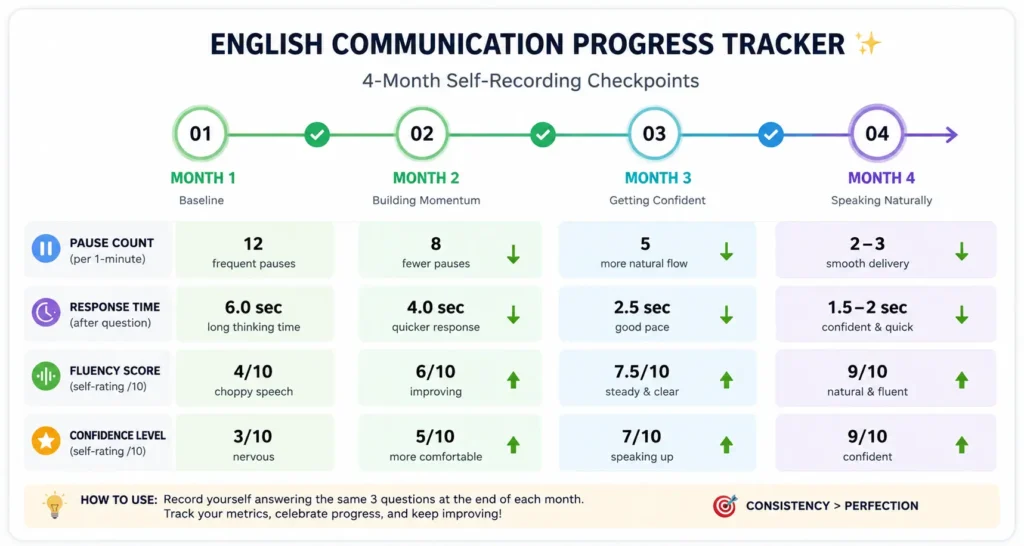
- Response time: how quickly you start answering after a question ends
- Number and length of pauses in a 2-minute unscripted answer
- Whether you complete full sentences or trail off mid-thought
- How long you can sustain a conversation before defaulting to short answers
Pronunciation
- Whether the same flagged sounds keep recurring in ELSA week over week, or whether the list is shrinking
- Whether people ask you to repeat yourself less often in real conversations, not just in-app scores
Grammar
- Whether your mistake log shows the same 3–4 errors repeating after a month — if so, that’s your actual priority
Vocabulary
- How many new words you’ve actually used unprompted in a real conversation, not just recognized when you heard them
Confidence
- Willingness to start a conversation without being asked first
- Ability to answer a question you didn’t prepare for without a long pause
A simple monthly check: record yourself giving the same 90-second self-introduction once a month. Don’t just listen for grammar — count your pauses and note whether your response time feels faster. This single before/after comparison, kept over 3–4 months, tells you more than any app’s internal progress chart.
A Simple English Speaking Progress Tracker for AI Learners
A progress tracker can help you determine whether your English practice is improving your real communication skills. Instead of relying on a single AI score, compare similar speaking tasks over time and look for changes in clarity, hesitation, grammar, and your ability to respond without a script.AI can explain anything, but explanation alone won’t make you remember it—here’s how to turn AI into a tool for stronger memory and better recall.
What Should You Record?
Use the same type of speaking task every week, such as a two-minute self-introduction, a short explanation of your studies, or an answer to a common interview question.
Record these indicators:
1. Speaking duration: How long can you explain an idea before losing your train of thought?
2. Long pauses: How many noticeable pauses occur while you search for words or reorganise a sentence?
3. Repeated grammar errors: Which errors appear more than once, and are they becoming less frequent?
4. Vocabulary retrieval: Can you use recently practised words without reading a list?
5. Message clarity: Can another person understand the main point without asking you to explain it again?
6. Response flexibility: Can you answer an unexpected follow-up question instead of repeating a memorised response?
Example of a Weekly Progress Record
Week 1: Record a two-minute answer about your studies. Note the main grammar errors, long pauses, and words you could not retrieve.
Week 2: Repeat the same task under similar conditions. Review whether the same errors appear and whether you can complete your explanation more comfortably.
Week 3: Practise a related topic without preparing a script. This checks whether your learning transfers beyond the original answer.
Week 4: Repeat the first task and compare the recordings. Identify one improvement and one remaining weakness.
This is an illustrative tracking process, not a scientific assessment of proficiency. Your results may vary with fatigue, familiarity with the topic, nervousness, and recording conditions.
How Should You Interpret the Results?
If you make fewer recurring mistakes but still pause frequently, continue practising spontaneous responses. If your speaking becomes smoother but listeners struggle to understand certain words, add targeted pronunciation practice. If you perform well with AI but struggle with people, increase real-world speaking practice and gradually introduce less predictable conversations.
Do not attempt to fix every weakness simultaneously. Choose the problem that most affects your communication, practise it consistently, and reassess it after a reasonable interval.
The purpose of tracking is to make your next practice session more useful. It is not to achieve a perfect score inside an application.
Decision Tree — Which AI English Tool Should You Use?
What’s your biggest English communication problem?
├── People ask you to repeat yourself?
│ → ELSA Speak (pronunciation analysis) + Cambridge Dictionary (reference)
│
├── Freezing or going blank mid-conversation?
│ → ChatGPT (Voice) — unlimited low-stakes retries
│
├── Complete beginner, minimal vocabulary?
│ → Duolingo first, then ChatGPT once basic sentences are solid
│
├── Grammar mistakes in speech, but writing is fine?
│ → ChatGPT (explanation) + spoken repetition, not just reading the rule
│
├── Interview or presentation coming up?
│ → ChatGPT role-play with your actual resume/topic fed in
│
├── Professional/workplace tone and meetings?
│ → ChatGPT (scenarios) + ELSA Speak if pronunciation is also a factor
│
└── Want accent variety (British, Australian, etc.)?
→ ChatGPT (flexible) over Speak (American-only) or ELSA (primarily American-oriented)
Best AI English Tools for Indian Students
For Indian students, English communication practice often needs to cover more than everyday conversation. Campus placement interviews, HR rounds, group discussions, presentations, internships, and workplace emails can all require different communication skills.
A practical combination is to use ChatGPT Voice for speaking and interview practice, ELSA Speak for recurring pronunciation problems, and Grammarly or ChatGPT for written communication. If you are starting from a very basic level, begin with structured beginner lessons before moving into open-ended speaking practice.
The goal is not to remove your natural accent. The goal is to speak clearly, respond with less hesitation, and communicate your ideas confidently in situations that matter for college and work.
Best AI Tools for Learning English Communication Skills for Indian Students and Job Seekers
Generic global roundups skip this entirely, which is where most of them lose usefulness for this audience.
Mother-Tongue Influence in Pronunciation
Many Indian English speakers carry specific, predictable patterns from their first language — for instance, Tamil and Hindi speakers often add a vowel sound before words starting with certain consonant clusters (“school” becoming closer to “iskool”), or don’t distinguish between certain vowel sounds English treats as separate. ELSA Speak’s sound-by-sound feedback is genuinely useful here because it flags the specific recurring sound rather than a vague “accent” comment.
Campus Placement Interviews
Use the ChatGPT interview prompt above with your actual resume pasted in. Ask specifically for a panel that follows up based on your answers, since fixed-script interview prep is a common trap — real interviewers rarely ask exactly what you rehearsed.
HR Interviews and Group Discussions
GDs are hard to simulate one-on-one since the dynamic is inherently multi-person, but you can still use ChatGPT to practice structuring a 60-second opinion on a topic and timing yourself saying it out loud.
Presentations and Classroom Communication
Record yourself explaining a topic for 2 minutes, run the recording through ELSA Speak for pronunciation feedback, then separately ask ChatGPT to review the structure and clarity of the same explanation.
Email and Written Communication for Internships
Draft in Grammarly for grammar accuracy, then ask ChatGPT whether the tone matches a formal Indian workplace context or reads as too casual for a first email to a hiring manager.
Working With International Colleagues
Practice with ChatGPT Voice using scenarios involving different accents and communication norms, since remote and hybrid work increasingly means talking with colleagues across regions, not just within India.
A realistic practice flow for interview prep: Interviewer (ChatGPT, primed with your resume) asks “Tell me about yourself” → You answer out loud, unscripted → Feedback (ChatGPT) flags filler words, weak structure, or grammar slips, specifically → You retry the same question with the fix applied → You repeat with a friend or mentor before the real interview.

Best AI English Speaking Apps for Employees and Working Professionals
The best AI English-speaking app for an employee depends on whether the main challenge is speaking in meetings, preparing for interviews, improving pronunciation, or writing professional messages. A flexible conversation assistant can help with realistic workplace scenarios, while a pronunciation-focused application may be more suitable when unclear speech is the main concern.
For workplace English, choose tools according to the task you need to practise rather than looking for one application that promises to improve every communication skill.
1. ChatGPT Voice for Meetings, Interviews, and Workplace Conversations
ChatGPT Voice can be used to practise spoken conversations, simulate interview questions, rehearse presentations, and prepare for difficult workplace discussions. You can also ask for feedback on the clarity and structure of your answers.
Example: You have to explain a delayed project to your manager. Ask the AI to act as your manager, ask challenging follow-up questions, and evaluate whether your explanation is clear, professional, and specific.
A useful prompt is:
“Act as my manager in a realistic workplace conversation. I need to explain why a project deadline has been delayed. Ask me questions one at a time and respond naturally to my answers. Do not give me a prepared script. After the conversation, identify unclear sentences, unnecessary filler words, and opportunities to communicate more professionally.”
Official information: https://help.openai.com/en/articles/20001274-chatgpt-voice
2. ELSA Speak for Pronunciation and Speech Clarity
ELSA Speak is worth considering when pronunciation, stress, or intonation is a recurring difficulty. Its official documentation describes AI-based pronunciation feedback and practice.
For example, an employee who is regularly asked to repeat certain words can practise those words and sentences, review the feedback, and repeat the exercise. The purpose is to improve intelligibility, not to eliminate a person’s natural accent.
Use a pronunciation tool alongside realistic speaking practice. Correctly pronouncing individual words does not automatically mean you can lead a meeting, explain a complicated idea, or respond confidently to a question.
Official information: https://elsaspeak.com/en/faqs/how-does-elsas-pronunciation-feedback-work
How to Check a Pronunciation Correction Before Practising It
When a pronunciation tool flags a word, verify the target pronunciation before repeating the exercise. Cambridge Dictionary provides UK and US audio for many entries, together with International Phonetic Alphabet (IPA) transcriptions.
For example, if you are unsure how to pronounce a word during interview practice, look it up in Cambridge Dictionary, listen to the available audio, and practise the word in a sentence. Then return to your speaking exercise and focus on whether the word is clear in connected speech.
Different English accents can have legitimate pronunciation differences. The goal is to improve clarity and understanding, not to treat every difference from one accent model as an error.
Official reference: https://dictionary.cambridge.org/help/phonetics.html
3. Grammarly for Professional Emails and Written Messages
Grammarly is more relevant when the challenge involves written communication. It can help identify grammar problems and improve clarity and tone, depending on the available plan and features.
For example, a message such as “Send me the report today” might be grammatically correct but sound too abrupt in some professional contexts. A more suitable alternative could be “Could you please send me the report by the end of today?”
The right wording depends on the relationship, urgency, and workplace culture. Use AI suggestions as options, not automatic replacements for your own judgement.
Official information: https://www.grammarly.com/plans
Which Tool Should an Employee Choose?
- If you hesitate during meetings, start with spoken role-play and unexpected follow-up questions.
- If listeners struggle to understand particular words, practise pronunciation and speech clarity.
- If your emails sound too informal, review grammar, tone, and sentence structure with a writing assistant.
- If you have an interview soon, rehearse questions related to the actual role and your experience.
- If you need to explain technical work, practise describing it to someone who has no specialist knowledge.
- If you work with international colleagues, combine speaking practice with exposure to different English accents and real conversations.
A 15-Minute Workplace English Practice Session
Spend five minutes practising a realistic workplace conversation, five minutes reviewing the most important feedback, and five minutes repeating your answer with the corrections applied.
For example, practise explaining a technical problem to a non-technical manager. First, give your explanation without a script. Next, identify jargon, unclear wording, and missing details. Finally, explain the same problem again using simpler, more precise language.
Once you are comfortable with the exercise, test the skill in a real meeting or conversation. Keep confidential workplace information, client details, passwords, and internal documents out of consumer AI tools unless their use is permitted by your organisation and appropriate for the data involved.
AI practice is most useful when it prepares you to communicate more effectively with actual colleagues, managers, customers, and interviewers.
FAQ — AI Tools for Learning English Communication Skills
What is the best AI tool for learning English? There’s no single best tool — it depends on your specific bottleneck. ChatGPT is the strongest general starting point because it’s free and covers conversation, grammar, and vocabulary together; ELSA Speak is stronger specifically for pronunciation, and Speak is stronger for learners who want a fixed lesson sequence.
Which AI tool is best for English speaking practice? ChatGPT (Voice) and Speak are both built for spoken practice. ChatGPT offers more flexibility and a free tier; Speak offers more structure but only American-accented conversation and no lasting free option.
Can ChatGPT help me improve my English speaking? Yes — its Voice feature supports live spoken conversation, and you can direct it to role-play specific scenarios, correct you at chosen points, or simply let you talk without interruption. Its main limitation is that it isn’t a dedicated pronunciation-analysis tool.
What is the best free AI tool for learning English? ChatGPT’s free plan, because it covers conversation, grammar explanation, and vocabulary practice in one place without a paywall, unlike ELSA or Speak, whose free tiers are limited or trial-only.
Which AI tool is best for English pronunciation? ELSA Speak, because it’s built specifically around sound-by-sound speech analysis, with Cambridge Dictionary as a free reference for checking how a specific word should sound in UK or US pronunciation.
Can AI improve English communication skills? Yes, primarily by increasing how much you practice and giving fast, repeatable feedback. A 2025 systematic review of 30 studies found AI chatbots had a substantial positive effect on speaking fluency and reduced learner anxiety, though the same review noted persistent limits in speech-recognition accuracy and, in some cases, increased anxiety for specific learners.
Is AI better than a human English tutor? No — AI is more available and usually cheaper, but human tutors remain stronger on cultural nuance, unpredictable real conversation, and pattern recognition across weeks of your progress.
How can I practice English conversation with AI? Use ChatGPT Voice or Speak, assign a specific scenario (interview, meeting, casual chat) rather than open small talk, and specify when you want to be corrected — during the conversation or only afterward.
Can I learn English using ChatGPT for free? Yes, using the ChatGPT Free plan, though usage limits can apply and tighten during high-demand periods.
How long should I practice English with AI every day? Ten focused minutes daily — as in the S.P.E.A.K. method above — produces more consistent progress than occasional hour-long sessions.
Which AI tool is best for English interviews? ChatGPT, using a role-play prompt that feeds in your actual resume and simulates an interviewer asking follow-up questions based on your specific answers, not a generic script.
Can AI improve English fluency? It can meaningfully improve practice volume, confidence, and targeted error correction. But fluency built purely through AI conversation should still be tested against real human conversation, since AI defaults toward one accent standard and can’t fully simulate the unpredictability of a live discussion.
Can AI Help Me Speak English Without Translating From My Native Language?
AI can provide repeated practice that helps you respond more directly in English. Use short conversations, familiar topics, and follow-up questions that require you to form your own answers rather than translate prepared sentences. Gradually introduce unfamiliar topics and less preparation time. AI practice may help, but it does not guarantee that you will stop translating mentally.
How Can I Improve My English Communication Skills at Work?
Practise the situations you encounter at work, such as explaining a delay, asking for clarification, participating in meetings, and responding to interview questions. Use an AI assistant to simulate the conversation, review your clarity and tone, and repeat the exercise. Apply what you learn in real workplace conversations when appropriate.
What Is the Best AI Tool for Improving English Work Messages?
A writing assistant such as Grammarly or a general-purpose assistant such as ChatGPT can help revise work messages for grammar, clarity, and tone. The best choice depends on your workflow and the features available to you. Always review the final wording to ensure it preserves your meaning and does not introduce an incorrect deadline, commitment, or fact.
Can I Improve English Communication Skills With AI in 10 Minutes a Day?
Ten minutes can provide a manageable daily practice session. For example, spend four minutes speaking, three minutes reviewing important mistakes, and three minutes repeating corrected sentences. Consistent practice is easier to maintain than occasional long sessions, but the time required to make noticeable progress varies by learner.
Should I Focus on Accent or Pronunciation First?
Focus on intelligibility first: whether listeners can understand your words and follow your message. Work on sounds, word stress, and intonation that repeatedly cause confusion. You do not need to eliminate your natural accent to communicate effectively.
How Can I Practise English for a Job Interview With AI?
Ask the AI to act as an interviewer for the specific job you want. Answer questions aloud, request follow-up questions based on your responses, and review your clarity, structure, and recurring grammar errors afterward. Practise explaining your actual experience honestly instead of memorising impressive-sounding answers.
How Can I Know Whether an AI English Tutor Is Worth Paying For?
First, use an available free option consistently and identify the problem you cannot solve with it. A paid tool may be worthwhile if you need a specific feature, structured course, or more detailed pronunciation feedback. Compare current pricing, limits, cancellation terms, and the features included before subscribing.
Is AI English Practice Enough Without Talking to Real People?
No. AI can provide repeatable, low-pressure practice, but real conversations introduce different accents, interruptions, social cues, and unexpected responses. Combine AI practice with conversations involving classmates, friends, teachers, colleagues, or language partners to check whether your skills transfer beyond the application.
How Can Beginners Practise English With AI Without Feeling Overwhelmed?
Start with short conversations about familiar topics and ask the AI to use simple language. Request one question at a time and feedback on only one or two important mistakes per session. Add more challenging topics and longer answers as your confidence and vocabulary develop.
The Bottom Line
If you’re only going to use one tool, start with ChatGPT — it’s free, and it covers more ground than any single specialized app. Add ELSA Speak only once your mistake log shows pronunciation as a recurring, specific problem, not a vague feeling that your accent “isn’t good enough.” Add Speak if you want someone else to structure your learning path and you’re comfortable paying for it. Use Duolingo only if you’re starting from close to zero. Use Grammarly for writing, not speaking. Use Cambridge Dictionary as your free reference tool throughout, regardless of what else you pick.
None of these AI tools for learning English communication skills replace an actual conversation with an actual person — they get you ready for one. The fastest path isn’t the learner with five apps installed. It’s the one who picked one tool, practiced it for ten honest minutes a day, and tested what they learned on a real person at least once a week.
About the Author
Nandhakumar — AI Tools & Digital Learning Writer (FutureFastAI)
Nandhakumar writes for FutureFastAI about AI tools, productivity software, and practical digital learning strategies for students and early-career professionals. His focus is not simply finding the tool with the longest feature list, but understanding which tool solves which problem and whether it is genuinely useful in everyday learning.
For English-learning content, his approach is practical and learner-focused: compare the actual use case, identify limitations, check current features and pricing, and look at how an AI tool fits into a real learning routine rather than treating every app as a replacement for a teacher or conversation partner.
This article was developed around a simple principle: the best English-learning tool depends on the learner’s bottleneck. Someone struggling with pronunciation may need a different tool from someone who freezes during interviews or a beginner who needs structured daily practice.
Where firsthand testing is available, observations are distinguished from information obtained from official product documentation, pricing pages, research literature, and independent sources. Features, availability, and pricing can change, so time-sensitive information is checked against current sources before publication or updating.
Last verified: August 12, 2026
Our Editorial Policy
FutureFastAI aims to publish practical, evidence-aware guides that help readers make better decisions about AI tools rather than simply promoting the products mentioned.
How we research AI tools
For product-related claims, we prioritise the official product website, documentation, pricing pages, and product announcements. When a claim requires additional context, we compare reputable independent sources and, where relevant, research papers or user experiences.
We do not treat a product’s marketing claims as independent evidence of effectiveness. A feature existing inside an app does not automatically mean that the feature produces better learning outcomes.
How we handle pricing and availability
AI tool pricing, free plans, trials, regional availability, and features can change frequently. We therefore include a verification date where appropriate and recommend checking the official pricing or subscription page before making a purchase.
When different sources report different prices, we do not present an uncertain figure as a guaranteed current price. Regional pricing, promotions, billing periods, app-store pricing, and account-specific offers can all affect the final amount.
How we evaluate recommendations
A tool is not recommended simply because it is popular.
We consider factors such as:
- Primary use case: What specific learning problem does the tool address?
- Practical usefulness: Can a learner realistically use it as part of a normal routine?
- Feedback quality: Does it provide useful information that can guide the next attempt?
- Accessibility: Is there a meaningful free option or low-cost way to try it?
- Limitations: What does the tool fail to do well?
- Transfer: Can the practice reasonably help the learner perform better outside the app?
- Fit: Is the tool appropriate for the learner’s level and goal?
This is why the article does not rank every tool from “best” to “worst.” A pronunciation specialist and a conversation partner are solving different problems.
How we handle AI-generated information
AI tools can occasionally produce incorrect explanations, inaccurate corrections, outdated pricing information, or overly confident answers. We therefore do not assume that an AI-generated answer is automatically correct.
Important factual claims are reviewed against appropriate sources, and readers are encouraged to verify information that can change over time.
What we do not promise
We do not promise that using an AI English-learning tool will make someone fluent within a specific number of days or that any single app will work equally well for every learner.
Language improvement depends on starting level, consistency, practice quality, real-world exposure, and the specific communication skill being developed.
Our goal is to help readers make a better-informed choice — not to guarantee a particular result.
Updates and corrections
When important product information changes, such as pricing, major features, availability, or subscription structure, we aim to update relevant sections rather than allowing outdated information to remain indefinitely.
If you notice an inaccurate or outdated claim, contact FutureFastAI with the relevant section and source so it can be reviewed.