
6 Underrated AI Tools for Science Students Who Need Quick Explanations (2026)
Best AI Tools for Science Students Who Need Quick Explanations
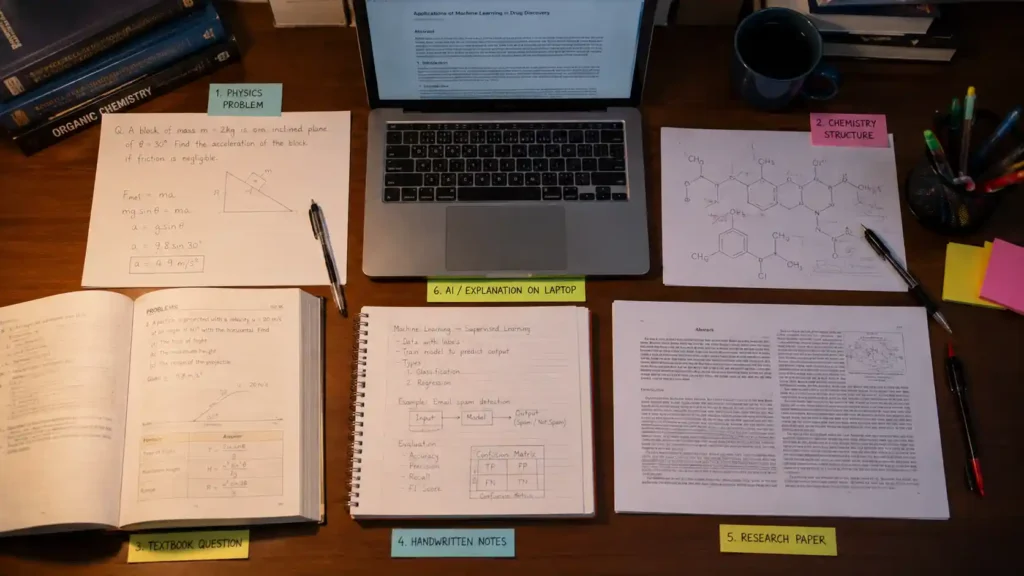
It’s 11:47 p.m. You have a physics problem open on your laptop, a chemistry mechanism scribbled across a notebook, and a paragraph from a research paper that somehow makes less sense every time you read it.
You know AI can probably help.
So you open the chatbot you already use.
You type the question. You get an answer. It looks convincing—but now you’re wondering whether you actually understand it, whether the explanation matches what you’re being taught, and whether you can trust the source behind it.
That’s the real problem with choosing AI tools for science.
It’s not that students have too few AI tools. It’s that they often use the wrong tool for the problem in front of them.
Most “best AI tools” lists solve this by giving you the same familiar names: ChatGPT, Gemini, Perplexity, Claude. They’re powerful general-purpose assistants, and there’s nothing wrong with using them.
But science students don’t always have a general-purpose problem.
Sometimes you need an AI tutor that can explain a difficult concept without simply giving you the answer. Sometimes you need to turn a handwritten equation or chemical structure into something a computer can understand. Sometimes you need to investigate whether a scientific claim is actually supported by published research. And sometimes the most useful tool is one that understands the syllabus you’re already studying.
That’s why this guide takes a different approach.
Instead of asking “Which AI tool is the most powerful?”, we’re asking:
“What problem are you trying to solve right now—and which tool is actually designed to help with it?”
Below, you’ll find six AI tools selected for specific science-study problems, with a focus on practical usefulness, accessibility, and where each tool fits into a real study workflow.
Because the best AI tool isn’t necessarily the one with the longest feature list.
It’s the one that helps you get unstuck without making you more confused.

Quick Answer
There isn’t one universally best AI tool for science students—the right choice depends on what you’re stuck on.
- Need a step-by-step conceptual explanation? Sizzle AI is a strong option for conversational, guided learning.
- Have a CBSE, JEE, or NEET-related doubt? Doubtnut is designed around Indian school and competitive-exam learning.
- Need to verify a scientific claim? Consensus searches scientific research literature to help you investigate whether the evidence supports it.
- Can’t understand a sentence in a research paper? Explainpaper lets you highlight confusing text and get an explanation of that specific passage.
The key is to match the tool to the problem, rather than automatically opening the same general-purpose chatbot for every question.
In short: Sizzle AI for learning concepts, Doubtnut for Indian-syllabus doubts, Consensus for research verification, and Explainpaper for difficult paper passages.
Learning difficult subjects becomes much easier when you use the right study strategy. If you want a complete exam preparation system, read How to Prepare for Exams Using ChatGPT Step by Step: Powerful 2026 Student Guide and discover how students are using AI to build study plans, revision notes, mock tests, and smarter exam strategies.
| 👤 This guide is for you if… |
| 🧪 You’re a science student who regularly gets stuck on concepts, equations, or homework problems |
| 🧠 You want AI to explain the reasoning, not simply give you an answer |
| 📄 You read research papers but sometimes struggle with technical passages |
| 🔬 You need to check whether a scientific claim is supported by research |
| 🇮🇳 You’re an Indian student preparing for CBSE, JEE, NEET, or similar syllabus-based exams |
| 📚 You have multiple academic papers and need to decide which ones deserve a full read |
| 💡 You want specialized tools instead of relying on one general-purpose chatbot for everything |
| 🚫 This guide may NOT be for you if… |
| 💬 You only want a general-purpose chatbot for everyday questions |
| 🎓 You’re looking specifically for essay-writing or presentation-generation tools |
| 💻 You need AI coding tools rather than science-study tools |
| 🧑🔬 You need advanced professional/research software rather than student-focused tools |
| 📝 You’re looking for tools that simply give you final answers without explanation |
| 📖 You aren’t working with science, mathematics, STEM coursework, or academic research |
Best tool for each situation
| Your situation | Use this |
| You don’t understand why something happens, step by step | Sizzle AI |
| You have a CBSE/ICSE/JEE/NEET-syllabus doubt | Doubtnut |
| You have a handwritten equation you need in digital form | Mathpix Snip |
| One sentence in a research paper is blocking your understanding | Explainpaper |
| You need to check if a claim is actually backed by research | Consensus |
| You have several papers to get through before a deadline | Scholarcy |
Best tool by subject
| Subject | Primary pick | Why |
| Physics | Sizzle AI, then Mathpix for the equation itself | Sizzle explains the physics problem’s logic; Mathpix converts the messy notation |
| Chemistry | Sizzle AI for mechanisms, Mathpix for structures | Reaction mechanisms need conversational back-and-forth; chemical structures need OCR |
| Biology | Sizzle AI or Doubtnut (India syllabus) | Biology is concept-heavy, not calculation-heavy — a guided explainer fits better than a solver |
| Mathematics | Sizzle AI or Mathpix Snip | Sizzle for the reasoning behind a step, Mathpix when you need the equation itself digitized |
| Research papers | Explainpaper, Consensus, Scholarcy | Explainpaper for one confusing passage, Consensus for verifying a claim, Scholarcy for triaging a reading list |
If you’re an engineering student, don’t waste hours switching between random AI tools—see which AI tools actually fit your engineering branch, from coding and research to calculations and project work.
How These Tools Actually Work Together
These tools aren’t necessarily alternatives. In a real study session, you may use two or three of them in sequence, with each handling a different part of the task.
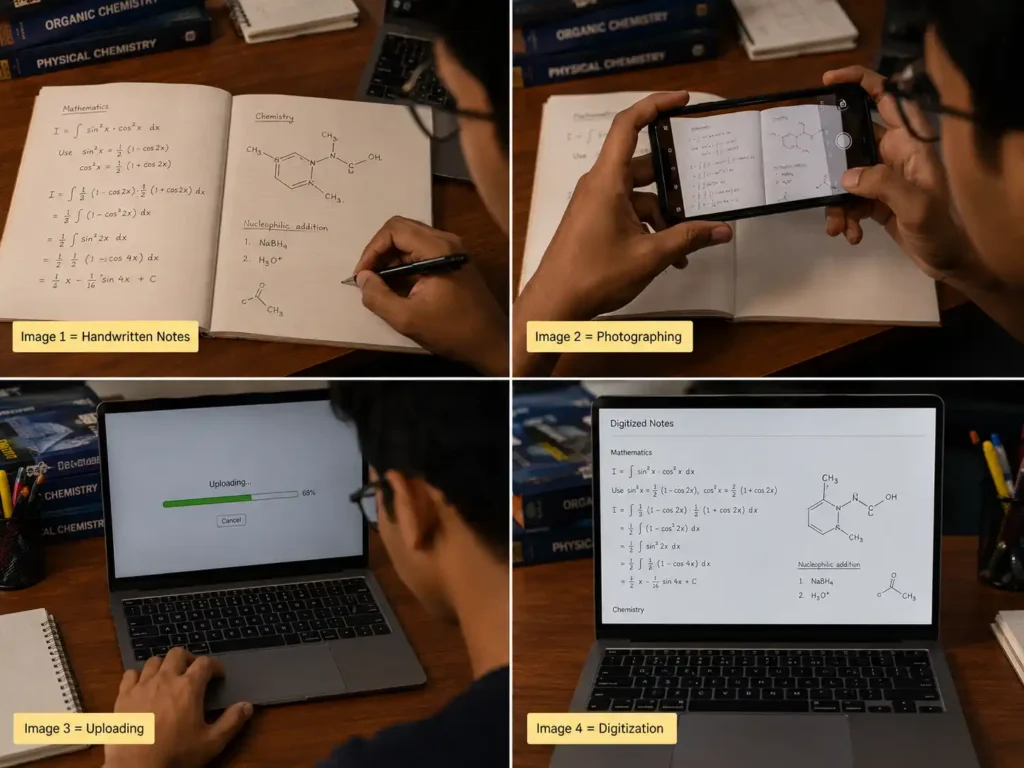
For example, imagine you’ve photographed a handwritten organic chemistry mechanism. You could use Mathpix Snip to turn the image into a clean digital representation, move that into Sizzle AI to work through why the mechanism proceeds the way it does, and then use Consensus to check whether the underlying scientific claim is supported by published research if you’re using it in an assignment.
Photo → digitize → explain → verify.
The important idea is not to find one AI tool that does everything. Use the right tool at each stage, and treat AI-generated explanations as something to understand and verify—not something to accept automatically.

Before You Choose an AI Tool
The fastest way to choose an AI tool is not to ask, “Which one is the best?”
Ask:
“What exactly am I trying to do right now?”
Struggling with difficult subjects? Explore our complete guide on AI Tools for Learning Difficult Subjects Faster and discover powerful AI tools that make complex topics easy to understand
A science student might have four completely different problems:
| Your problem | What you actually need |
| “I don’t understand this concept.” | A tutor that explains and guides you step by step |
| “Is this answer in my syllabus?” | A curriculum- or exam-focused learning tool |
| “Is this scientific claim actually true?” | A research and evidence-verification tool |
| “I can’t understand this research paper.” | A tool that explains difficult passages in context |
This distinction matters because AI tools are optimized for different jobs. A general chatbot may give you a perfectly reasonable answer, but a specialized tool can sometimes save time by starting closer to the problem you actually have.
A simple rule: don’t start with the tool—start with the bottleneck
Before opening an AI tool, identify what is slowing you down:
Understanding → use a learning-focused tutor
Solving → use a problem-solving or calculation tool
Reading → use a paper/document explanation tool
Researching → use a research-focused search tool
Verifying → check the claim against reliable sources
This also helps prevent a common study mistake: outsourcing the thinking instead of using AI to support it.
If an AI gives you an answer you cannot explain in your own words, you haven’t necessarily learned the concept—you’ve only received an answer.
Use AI to break down, question, compare, practice, and verify. Then do the final reasoning yourself.
The goal isn’t to get an answer faster. It’s to understand the answer well enough that you could solve a similar problem without the AI next time.
The tools
Sizzle AI
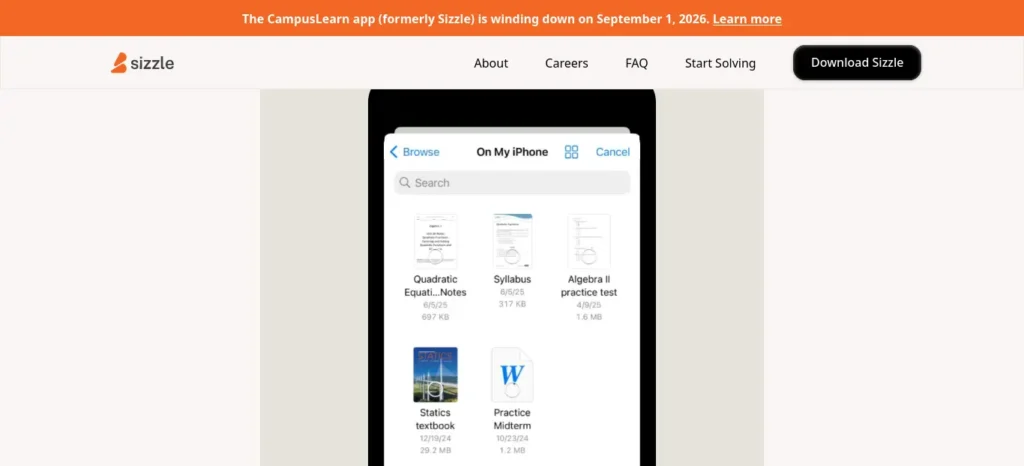
If it’s 11 PM and you’ve got one physics problem you genuinely don’t understand — not “what’s the answer,” but “why does this step follow from that one” — Sizzle AI is built for exactly that moment. It’s a free, conversational tutor that walks through math, physics, chemistry, and biology problems interactively, and you can keep asking “why?” at any point in its explanation until it actually clicks.
| Field | Detail |
| Tool | Sizzle AI (sizzleai.com) |
| Category | Conversational STEM problem-solving tutor |
| Best for | Step-by-step explanations of a specific homework problem |
| Free availability | Full product, unlimited use, no paid tier found |
| Main strength | Guides you through reasoning instead of giving a final answer |
| Main limitation | Not built for research papers or open-ended concept exploration |
Most competitors in this space — Photomath, Symbolab, and similar apps — show you the final steps but lock the detailed reasoning behind a subscription. Sizzle doesn’t gate that part, which is the main reason it’s worth knowing about even though it’s a smaller company than the AI giants.
Who should skip this: if you’re trying to understand a broad concept rather than solve one specific problem — say, “explain evolution to me” rather than “why does this Punnett square work this way” — a general chatbot’s Study Mode will probably serve you better. Sizzle is built around a problem in front of you, not an open-ended topic.
My take: I’d reach for this before ChatGPT for any single homework problem where I don’t understand the logic, specifically because it doesn’t ask me to prompt-engineer my way into a good explanation — the conversational format does that work automatically. The trade-off is that it’s a smaller, newer company, so I wouldn’t build a whole study routine around it without a backup plan if the product changes.
Doubtnut
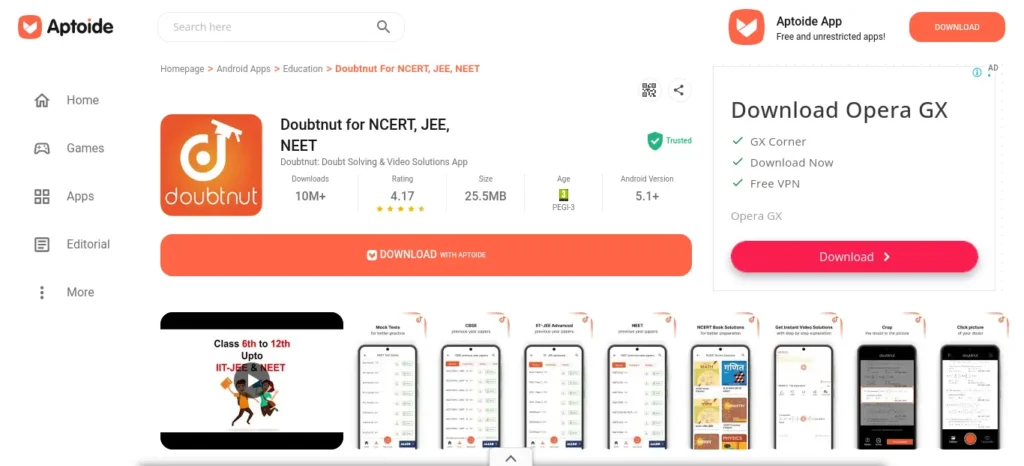
If you’re on a CBSE, ICSE, or state-board syllabus, or grinding through JEE or NEET prep, Doubtnut solves a problem most global AI tools quietly get wrong: they don’t know your syllabus. Doubtnut does. Photograph a question from your NCERT textbook or a JEE practice paper and it returns a step-by-step solution — text or video — mapped to the exact curriculum you’re being tested on.
| Field | Detail |
| Tool | Doubtnut (doubtnut.com) |
| Category | India-specific syllabus-matched doubt solver |
| Best for | CBSE/ICSE/state-board homework and JEE/NEET practice questions |
| Free availability | Core doubt-solving and NCERT solutions are free |
| Main strength | Answers are matched to the Indian curriculum, not generalized |
| Main limitation | Narrow scope — built for exam-pattern questions, not open exploration |
Scenario: you’re revising for a Class 12 Chemistry board exam and hit an NCERT question that doesn’t match the way your teacher explained it in class. A general chatbot will give you a technically correct answer that may use different notation or skip steps your exam expects shown. Doubtnut’s solution is built around exactly your textbook and exam format.
Who should skip this: students outside the Indian curriculum system, or anyone who wants conceptual exploration beyond a specific exam question — Doubtnut is built for “solve this exact question,” not “help me understand this topic broadly.”
My take: for JEE and NEET aspirants specifically, I’d put this ahead of any general AI tool for exam-pattern questions, simply because syllabus accuracy matters more than general correctness when a specific mark scheme is involved. It’s not really “hidden” inside India — it’s well known in exam-prep circles — but it’s almost invisible in the global AI-tools content that most guides recycle.
Mathpix Snip
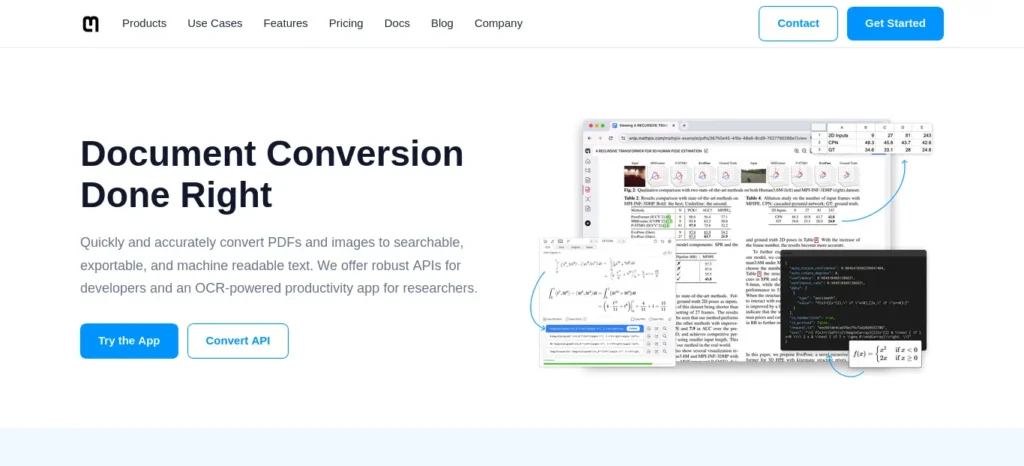
This one doesn’t explain anything — and that’s exactly the point. Before you can ask any AI tool to explain a handwritten equation, someone has to get that equation into a form the AI can actually read. Mathpix Snip does that conversion: screenshot or photograph a printed or handwritten equation, chemical structure, or table, and it returns clean LaTeX, Markdown, or Word format in seconds.
| Field | Detail |
| Tool | Mathpix Snip (mathpix.com) |
| Category | Math and chemistry notation OCR |
| Best for | Converting handwritten equations, chemistry diagrams, and scanned pages into digital text |
| Free availability | Free tier: limited monthly snips plus 20 free PDF pages/month |
| Main strength | Purpose-trained on mathematical and chemical notation specifically |
| Main limitation | It’s a conversion tool, not a tutor — pair it with something else for the actual explanation |
Scenario: your professor’s slides are a scanned PDF full of integrals and you need to paste one specific equation into a chatbot to ask about it, but typing it by hand would take ten minutes and probably introduce a typo. Mathpix turns that into a ten-second screenshot.
Who should skip this: if your coursework is mostly text-based and light on equations or chemical structures, you probably won’t use this often enough to justify learning a new tool — a general chatbot’s built-in image reading will likely be good enough.
My take: this is the tool almost every other “AI study tools” article forgets to mention, and it’s often the actual bottleneck between “I have a confusing problem” and “I can get help with it.” The free tier’s monthly limit runs out fast if you’re digitizing a full problem set, and at $4.99/month (about ₹477) the paid tier is one of the cheapest upgrades on this list if you hit that wall regularly.
Explainpaper
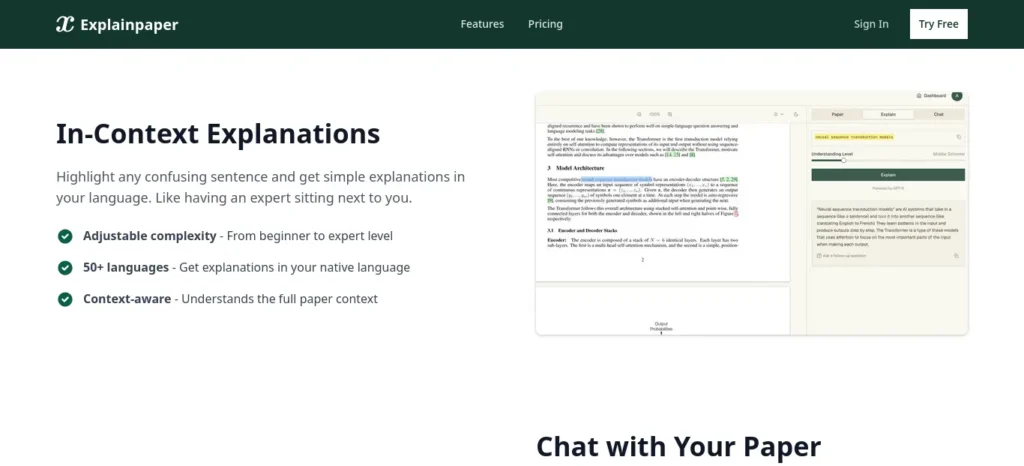
Upload a research paper, highlight the exact sentence that’s confusing you, and Explainpaper explains just that passage in plain language — not a summary of the whole paper, the specific line you’re stuck on, in context.
| Field | Detail |
| Tool | Explainpaper (explainpaper.com) |
| Category | Highlight-to-explain research paper reader |
| Best for | Understanding one specific confusing passage inside a paper you’re already reading |
| Free availability | Free tier with a limited monthly volume of explanations |
| Main strength | Explains the exact highlighted sentence, not the whole document |
| Main limitation | Doesn’t search for papers — you need the PDF already in hand |
Pasting a whole PDF into a general chatbot and asking “explain this” often gets you a summary of the paper’s overall argument, not help with the one paragraph you’re actually stuck on. Explainpaper’s highlight-first design solves that specific mismatch.
Scenario: you’re working through a methods section for a final-year project and one sentence about statistical significance is written in a way that assumes background you don’t have. Instead of reading the whole paper again hoping it clicks, you highlight that one sentence and ask for a plainer version.
Who should skip this: if you need to find papers in the first place rather than understand one you already have, this isn’t the right tool — pair it with Consensus or your library database for discovery, then bring the PDF here.
My take: the free tier covers occasional paper-reading fine, but if you’re working through primary literature weekly for a course, you’ll hit the monthly cap fast, and at that point Plus ($12/month, about ₹1,147) becomes worth budgeting for.
Consensus
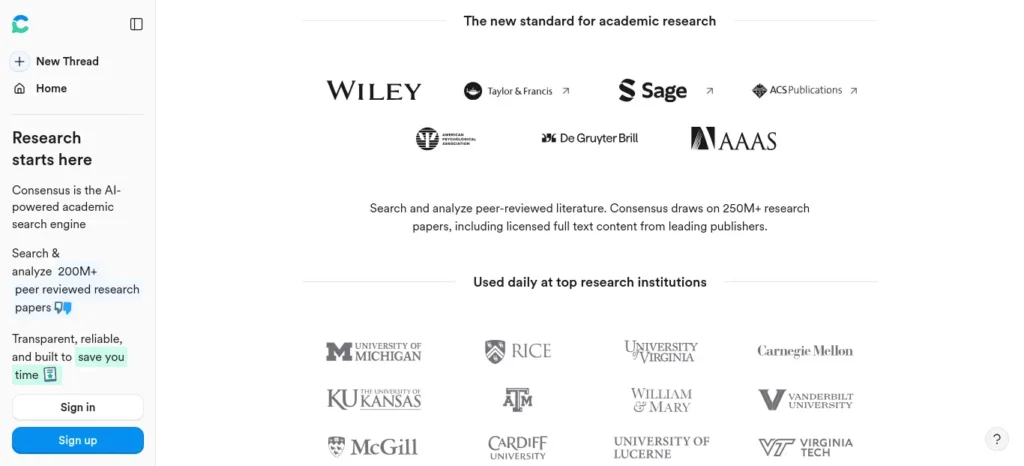
Consensus answers a science question by searching 200+ million peer-reviewed papers and showing you a “Consensus Meter” — a simple visual indicator of how much of the actual research agrees, disagrees, or is mixed on a claim. It generates its summary only from retrieved papers, not from general AI knowledge, which matters if you’re trying to cite something correctly rather than just sound informed.
| Field | Detail |
| Tool | Consensus (consensus.app) |
| Category | Evidence-based academic search engine |
| Best for | Checking whether a scientific claim is actually supported by research before you cite it |
| Free availability | Free tier with a monthly allowance of AI-powered searches |
| Main strength | Answers are generated only from retrieved peer-reviewed sources, reducing fabricated citations |
| Main limitation | Only searches academic literature — won’t help with a textbook-level concept explanation |
Scenario: you’re writing an assignment and want to state that a specific supplement “improves memory” — a claim you’ve seen repeated online. Instead of trusting a general chatbot’s confident-sounding answer, you run the claim through Consensus and see the actual split across studies before you write the sentence.
Who should skip this: if you need help understanding a textbook concept rather than checking a research claim, this isn’t built for that — it only searches peer-reviewed literature, so it won’t explain photosynthesis to a confused first-year student.
My take: I’d treat this as the fact-check step, not the first stop. It’s the tool I’d use after getting an explanation somewhere else, specifically to make sure the claim I’m about to write down is actually defensible. One caveat worth being upfront about: even peer-reviewed research can be preliminary, contested, or later retracted, and an AI summary of a single paper can still miss nuance a human reviewer would catch — treat the Consensus Meter as a starting signal, not a final verdict.
Before you start writing your assignment, it’s important to know how to use AI for college research projects effectively. A strong research process helps you find credible sources, organize ideas, and avoid common mistakes that can lower your grades.
Scholarcy
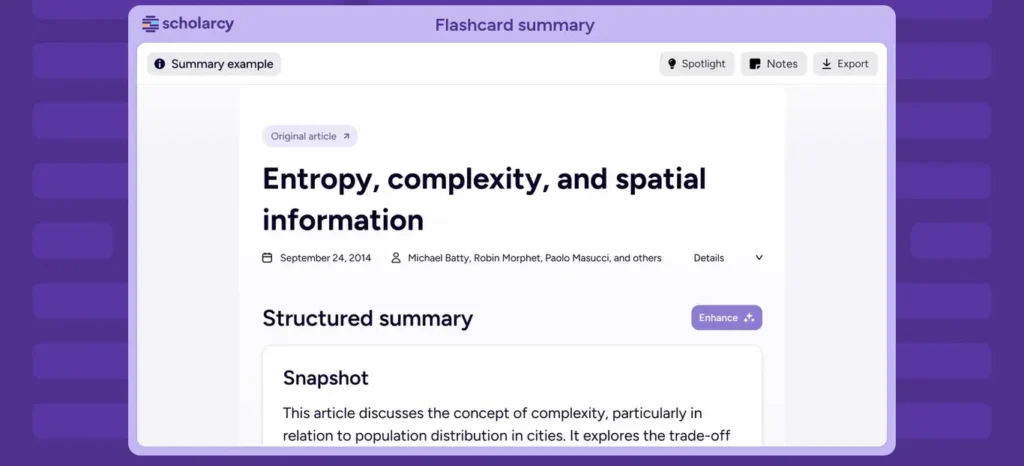
Scholarcy takes a stack of academic papers and turns each one into a structured summary flashcard — introduction, methodology, results, conclusions — instead of a wall of text. It’s built for the specific situation where you have several papers and limited time, not for reading one paper deeply.
| Field | Detail |
| Tool | Scholarcy (scholarcy.com) |
| Category | Academic paper summarizer and flashcard generator |
| Best for | Triaging a long reading list before deciding which papers deserve a full read |
| Free availability | Free tier: up to 10 summaries per day, one at a time |
| Main strength | Structured, consistent extraction format across every paper — not a generic summary |
| Main limitation | Daily free-tier cap is restrictive if you’re reading multiple papers in one sitting |
Scenario: your professor assigns eight papers for Friday’s seminar and you have ninety minutes on Tuesday night to figure out which three are actually worth a full read. Running them through Scholarcy first gives you enough of each paper’s shape to make that call.
Who should skip this: if you’re only reading one or two papers occasionally, the free tier already covers you and a subscription isn’t worth it — this tool earns its cost specifically during reading-heavy weeks, not as a everyday default.
My take: it’s UK-built with a genuinely long track record in the academic-tools space rather than a brand-new entrant, which matters if you’re deciding whether to trust it with a semester’s worth of reading. The lack of a native mobile app (browser-only, even on phones) is a real inconvenience if most of your reading happens on a commute.
Ranked: most hidden gem to most likely to go mainstream
- Sizzle AI — fully free, genuinely conversational, still barely covered outside specialist reviews.
- Mathpix Snip — solves a step almost every other guide skips entirely.
- Explainpaper — respected in academic-tools circles, rarely crosses into general student content.
- Scholarcy — established with real institutional adoption, but still mostly known inside research-methods circles.
- Doubtnut — well known within India’s exam-prep world, hidden mainly by geography rather than genuine obscurity.
- Consensus — growing fastest of the six, with a distinctive, shareable feature that makes it the most likely to become a familiar name soon.
If you’re still unsure whether ChatGPT or Perplexity is the better choice for your next assignment, this side-by-side comparison can help you choose the right tool without wasting time.
When you shouldn’t use AI at all
If the question is graded on your own working — a lab report’s analysis section, an exam-style derivation you’re meant to produce independently — running it through any of these tools first and copying the output defeats the actual assignment. Use them to understand why something works, then close the tool and try writing the answer yourself before you check it against what the AI said.
Struggling to remember what you studied? After improving your focus, the next step is turning your notes into interactive quizzes. Learn how to create practice tests from notes using AI to revise smarter, test yourself faster, and boost exam confidence.
Always verify important science answers
Every tool on this list can be wrong, including the ones that cite sources — a citation only proves a paper exists, not that the AI summarized it correctly. Before you rely on an explanation for an exam or a cited claim in an assignment, cross-check it against your textbook, your lecture notes, or a second source. This matters more, not less, for tools that sound confident and well-referenced.
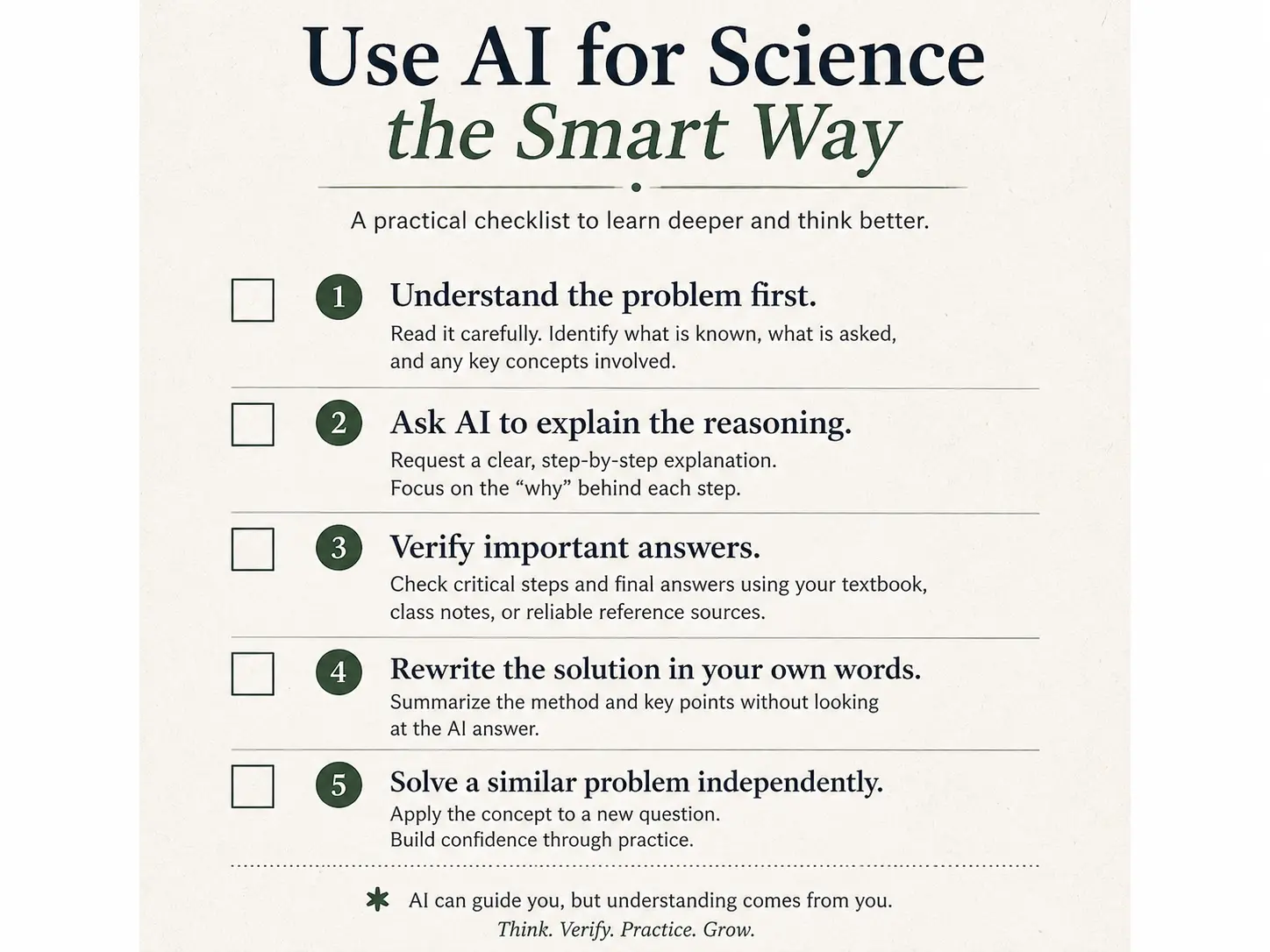
A quick academic integrity note
Using an AI tool to understand a concept before you write your own answer is generally fine. Submitting an AI-generated explanation as your own original work usually isn’t — check your institution’s specific policy, since these rules vary by university and even by course.
Want to learn the practical ways students are already using AI in everyday learning? Read our complete guide on How Students Use AI to Study Smarter (Without Cheating) and discover 12 proven techniques to improve learning, revision, and exam preparation.

Frequently asked questions
What is the best AI tool for quick science explanations? There isn’t one universal answer — it depends on the type of question. Sizzle AI is the strongest pick for a step-by-step walkthrough of a specific problem, because it’s free, conversational, and built around guiding you to the reasoning rather than the final answer.
Which AI tool is best for science homework help? For homework specifically, match the tool to the subject: Sizzle AI for a problem you don’t understand the logic behind, Mathpix Snip if you first need to digitize a handwritten question, and Doubtnut if your homework follows an Indian school syllabus.
Which tool is best for research papers? It depends on what you’re doing with the paper. Explainpaper is best for understanding one confusing passage inside a paper you already have. Consensus is best for checking whether a claim is backed by research. Scholarcy is best for triaging a long reading list quickly.
Which tool is best for Indian science students? Doubtnut is the clearest fit for CBSE, ICSE, JEE, and NEET students specifically, since its answer library is matched to the Indian curriculum rather than generalized from global content. For everything outside syllabus-specific questions, the other five tools work the same regardless of location.
How FutureFastAI Evaluates These Tools
Every tool in this guide was evaluated using publicly available product pages, pricing information, app listings, update histories, and independent reviews available as of the verification date above. We did not personally test every tool end-to-end, so this article does not claim first-hand testing or personal experience with every product.
A tool was considered for inclusion only when it met our core quality criteria:
- It appeared to be actively maintained, based on recent updates, release notes, or other current product activity.
- It addressed a specific science-study need rather than simply offering generic AI features.
- It had a usable free plan, free access option, or relatively affordable student pricing.
- Its current availability and core features could be reasonably verified from public sources.
We also excluded tools where publicly available information raised significant concerns about outdated development, unclear product status, or recurring unresolved billing issues. This is an intentional quality filter—not an omission.
Important: AI tools, pricing, student discounts, usage limits, and free plans can change quickly. The information in this guide reflects what we could verify at the time of research, not a permanent guarantee. Before subscribing or paying for any tool, check its official website for the latest price, eligibility requirements, limits, and terms.
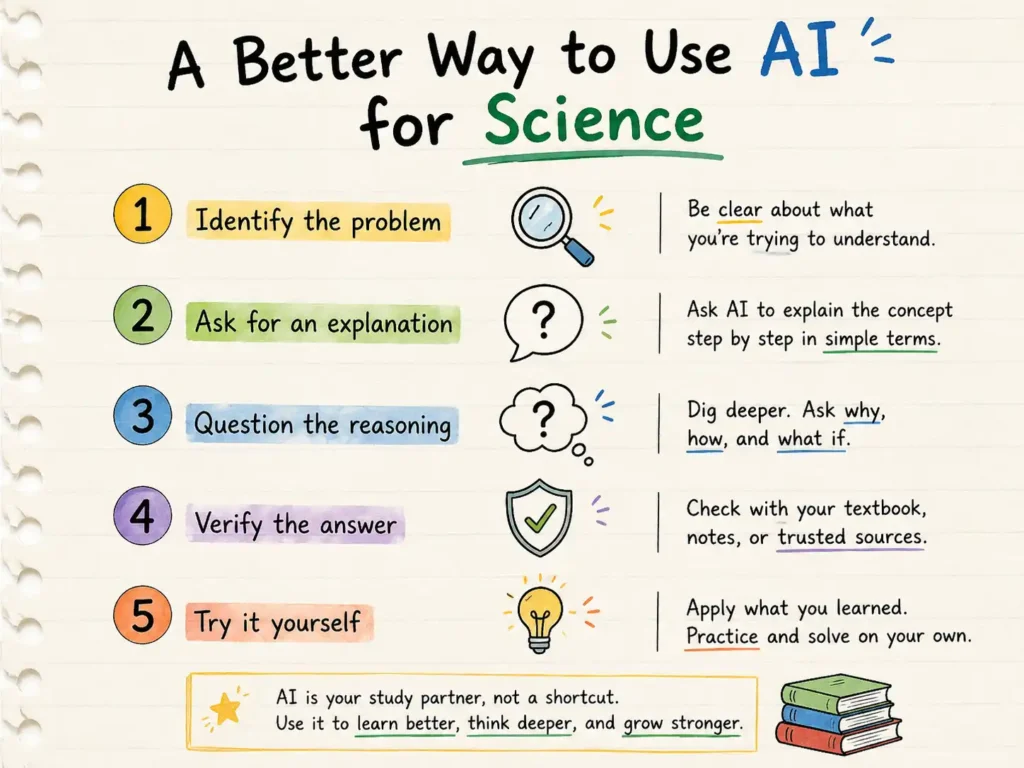
The One Thing to Remember
Match the tool to the problem in front of you—not simply to whichever chatbot you already have open.
A free conversational tutor, a syllabus-matched doubt solver, or a research-focused tool with strong citation support can outperform a general-purpose AI assistant when you need that specific job done well.
The best AI tool isn’t always the most powerful one. It’s the one that fits the task you’re trying to solve.
About the Author
Nandhakumar is the founder and creator of FutureFastAI, a practical AI resource focused on helping students and beginners discover useful AI tools and apply them effectively in their everyday learning and work.
His work focuses on researching and evaluating AI tools through a practical lens—looking beyond feature lists to understand who a tool is actually useful for, what problem it solves, how accessible it is, and where its limitations matter.
At FutureFastAI, Nandhakumar creates research-driven guides covering AI tools for studying, research, productivity, learning, and digital work. His goal is simple: help readers choose the right AI tool for the task instead of relying on the same general-purpose chatbot for everything.
For tool-comparison articles, FutureFastAI reviews publicly available product information, features, pricing, availability, and other relevant evidence. The site also clearly distinguishes researched information from first-hand testing and avoids presenting AI tools as universally reliable or suitable for every user.
FutureFastAI Editorial Policy
At FutureFastAI, our goal is to publish practical, accurate, and genuinely useful content about AI tools, technology, productivity, learning, and digital work.
We believe readers should be able to understand not only what a tool does, but also who it is for, where it works well, and where its limitations matter.
How We Create Our Content
Our articles are created with a focus on usefulness, accuracy, clarity, and real-world relevance. Depending on the topic, we may research information from official product pages, documentation, pricing pages, academic sources, app listings, release information, and other relevant publicly available sources.
We do not include a tool simply because it is popular. We consider factors such as:
- What problem the tool is designed to solve
- Who is most likely to benefit from it
- Key features and practical usefulness
- Free plans, pricing, and usage limitations
- Availability and accessibility
- Important limitations or drawbacks
- Relevance to the intended audience
- Whether the information can be reasonably verified
Accuracy and Verification
AI tools, pricing, features, availability, and usage limits can change frequently. We make reasonable efforts to verify important information before publication and update articles when significant changes are identified.
When current information is particularly important, readers should also check the tool’s official website before making a purchase or relying on a feature or pricing claim.
First-Hand Testing and Transparency
We distinguish between first-hand testing and information obtained through research.
If an article has not been personally tested end-to-end by the author or FutureFastAI team, we do not present it as personal experience.
Where appropriate, articles explain the basis on which tools were evaluated so readers can understand what has been researched, tested, or independently verified.
Reviews and Recommendations
Our recommendations are based on the specific use case discussed in each article.
There is rarely one AI tool that is best for everyone. A tool that works well for research may not be the best choice for studying, writing, coding, or productivity.
We therefore aim to explain both strengths and limitations rather than presenting every recommended tool as universally superior.
Pricing and Free Plans
Pricing, free tiers, student plans, usage limits, and promotional offers may change.
When we mention pricing or availability, the information reflects what we could verify at the time of research. Readers should confirm the latest pricing, eligibility requirements, and terms on the provider’s official website before subscribing.
AI-Assisted Content
AI tools may be used as part of our research, brainstorming, editing, or content-development workflow.
However, AI-generated output is not treated as automatically accurate. Important claims are reviewed and edited by humans before publication, and content is structured around the needs of the reader rather than generated simply to increase publishing volume.
Corrections and Updates
If we identify a factual error, outdated information, broken recommendation, or significant change affecting an article, we aim to correct or update the content.
When appropriate, updated articles may include a visible Last Updated or Updated on date so readers can understand when the information was most recently reviewed.
Independence and Disclosure
Our recommendations are based on usefulness and relevance to the reader.
If an article contains affiliate links, sponsored content, or another commercial relationship that could affect how a recommendation is presented, we will disclose that relationship clearly.
Affiliate relationships do not change our responsibility to describe a product’s limitations honestly.
Academic and Responsible AI Use
FutureFastAI encourages readers to use AI as a learning and productivity aid—not as a replacement for their own judgment, critical thinking, or academic responsibilities.
Students should follow the AI and academic-integrity policies of their school, college, or university before using AI-generated material in assignments, examinations, research, or other assessed work.
Our Editorial Standard
Our standard is simple:
Be useful. Be transparent. Verify important information. Explain limitations. Update when necessary.
We want FutureFastAI to be a resource readers can use to make better decisions about AI—not simply another website that publishes lists of AI tools.






One Comment